To Listen To The Full Audio Episode Click Here: The Daily Dose Podcast Audio
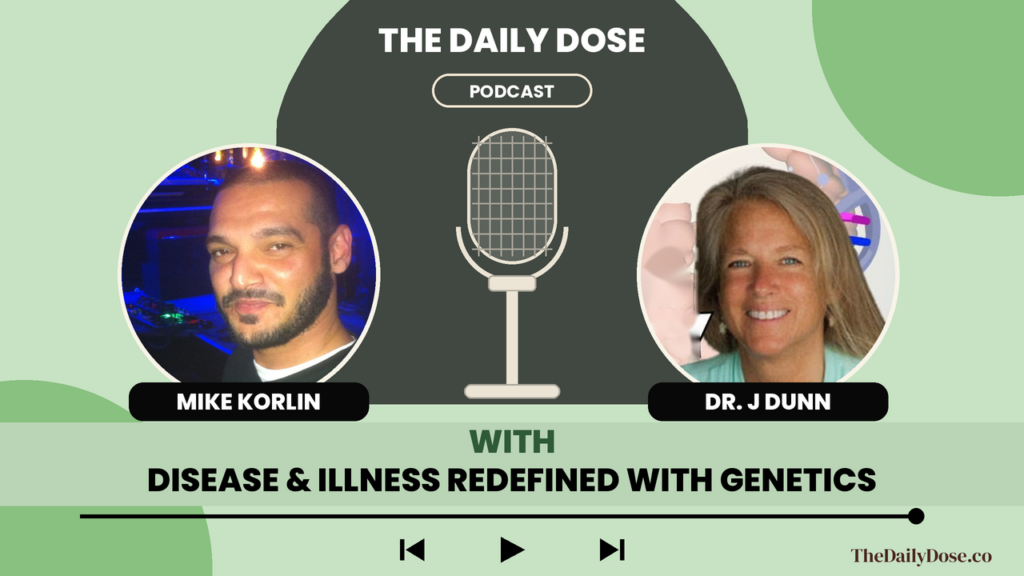
I sat down with Dr. J Dunn for this episode of The Daily Dose Podcast, and it was one of the longest and most eye-opening conversations I have recorded, about an hour and a half. I open the episode with a question I keep coming back to: the United States spent about $4.3 trillion on healthcare in 2021, roughly $12,900 per person, and yet most of us do not feel any healthier. Dr. Dunn came on to explain a different way of looking at that problem, one that starts with the genes that code for the enzymes in our bodies.
Everything below is a summary of what we talked about, based on the recording of the episode. It is her perspective and mine, shared for education. It is not medical advice, and nothing here is a diagnosis, a treatment plan or a promise of results. If you have a health concern, please talk to a qualified healthcare professional.
Key Takeaways
- Genetics is about risk, not destiny. Dr. Dunn explains that a family history can raise your risk, but diet, lifestyle, stress and environment all influence which genes are expressed.
- Enzymes are the heart of her approach. Our genes carry the code for enzymes that break down things like histamine, adrenaline, neurotransmitters and toxins, and a variant can make an enzyme work more slowly.
- Methylation, explained in plain language. She describes methylation as a way the body covers up genes, and explains why B vitamins, stress and mitochondria matter in her framework.
- Genes stay the same, but gene expression can change. A genetic test and an epigenetic test look at different things.
- She shared personal stories from her practice and her own life. I treat these as anecdotes, not as proof, and I said so in the episode.
- Privacy came up. We unboxed a home DNA kit on camera and talked about who sees your data and what happens to the sample.
Table of Contents
- Meet the Guest: Dr. J Dunn
- Genetics Is Risk, Not Destiny
- Why People React So Differently
- Ancestors, Natural Selection and a Modern World
- Methylation and Gene Expression in Plain Language
- Enzymes, Cofactors and a Personalized Approach
- Stories From Her Practice and Her Own Life
- Anxiety, Stress and the Biochemistry Behind the Story
- Fasting, Habits and Why Willpower Is Not Everything
- Medicine, Insurance and Cost
- Inside the Home DNA Kit
- Her Message to Listeners
- Where I Land After This Conversation
- FAQ
- Educational Disclaimer
Meet the Guest: Dr. J Dunn
In the episode I introduce Dr. Dunn as a geneticist who has practiced for more than 30 years, and the bio we published with the original episode adds more detail. It says she has a degree in natural sciences, a doctorate in chiropractic medicine and a certification in functional medicine, and that she has been a health care provider since 1988. The bio also credits her as the originator of Wholistic Kinesiology, Wholistic Methylation and MyHappyGenes, and as the author of two books, Wholistic Kinesiology and Perfect Health in Paradise.
What I wanted from the conversation was a plain-language explanation of her method. As I say in the intro, it goes a layer deeper than what we usually hear from modern medicine, and even deeper than the functional medicine approach many of us have learned about in recent years. If you want more on that side of the picture, I also talked with Dr. Victoria Andarcia in our episode on functional medicine.
Genetics Is Risk, Not Destiny
My first question was about the fundamentals: how does genetics as most of us understand it compare to what she works with? Dr. Dunn said there is a lot of misunderstanding out there. Yes, you can have a higher risk because a parent had a particular imbalance, but that does not mean you will get it. Diet, lifestyle, supplementation and stress levels can all influence which genes express. She mentioned the familiar saying that genetics loads the gun and the environment pulls the trigger.
That matched my own suspicion. I have heard “it’s your genetics” in doctors’ offices, and I never believed that was the whole story. She was just as clear that it is not all environment either. She told a personal story about her father, who was a heavy smoker and drinker and died of lung cancer in his fifties, while a close friend of his with similar habits lived about thirty more years. Her takeaway was that some people carry a genetic risk that makes the same habits much more dangerous, and that this is what got her looking into her own genetics. It is one family’s story, so take it as an illustration and not as data.
Why People React So Differently
A big part of the early conversation is about why two people in the same situation can have very different experiences.
Detox, sensitivity and metabolism
Dr. Dunn described couples who came to see her where one partner felt the house was full of chemicals and the other did not notice anything. In her view, genetic variants help explain why some people clear certain substances more efficiently than others. She made the same point about metabolism: two people can eat the same diet and end up in very different places.
The histamine example
I asked whether this applies to dusty or high-pollen environments, and that is where she gave the histamine example. She explained that there is a gene-coded enzyme that breaks down histamine. If you inherited the code that works well, you may not be bothered much by allergens. If you have a variant that works more slowly, histamine can build up, and the effects are not limited to a runny nose, sneezing and itchy eyes. She said it can also show up in the digestive system, in the brain as brain fog, and in the skin as hives or rashes.
She described the bigger idea this way: you get one set of genes from your mother and one from your father, and together they give the code for enzymes that break down histamine, adrenaline, neurotransmitters and toxins. A “black box” of unknowns became, for her, something that made logical sense. In the full interview she also names an enzyme called HNMT and explains that it relies on a methyl group, which ties in with the methylation discussion below.
I also published a short clip of this part of the interview. You can hear it in What Is Histamine Intolerance Explained, where we also go through the general educational side of histamine intolerance.
Ancestors, Natural Selection and a Modern World
I asked whether it matters where your parents came from. Dr. Dunn said that in some cases it can, but human beings are overwhelmingly the same and only a small percentage of variation affects our biology. To illustrate, she used the example of the Irish potato famine, where people who could hold on to body fat were more likely to survive and pass those genes on. She also brought up malaria, and the way a gene linked to sickle cell anemia is also linked to more resistance to malaria in regions where malaria is common.
From there we talked about how traits that helped our ancestors survive can work differently today, especially when food is plentiful. She also argued that we are exposed to pesticides, chemicals and hormone disruptors that earlier generations never faced, and that our bodies have not had time to adapt. That is her view, and I would encourage you to read widely on environmental exposures rather than take any one person’s word for it.
Methylation and Gene Expression in Plain Language
This was the part of the conversation I asked her to slow down on, because I had been stuck on a question: how can a gene be there from birth, stay dormant, and then one day start to express? She said it was a good question and that the answer can be confusing, so I will pass it along as she explained it, and she even asked me whether it was too much too fast.
Dormant genes
She used the BRCA gene as an example: you are born with it, but it does not necessarily cause problems until much later in life. In her framework, methylation is one reason. A methyl group, which the body makes from nutrients such as B12 and folate, can cover up a gene so it does not express. If methylation is low, the gene is more exposed to the environment, including toxins, chemicals, radiation and drugs such as antibiotics.
Mitochondria
Dr. Dunn also talked about the mitochondria, the part of the cell that turns food into energy in the form of ATP. She noted that mitochondria have a bacterial origin, and said that in her view damage to the mitochondria is a major factor when a gene starts to express and a health issue begins. She also described factors she believes lower methylation: stress, caffeine, gaps in the diet, the wrong forms of B vitamins, and genetic variants that make it harder to activate B12 and folate from food.
A fair caution here: the biology of gene expression is complex and still being studied. Treat this as her explanation from the conversation and a starting point for your own reading, not a complete scientific account.
Genes versus gene expression
Near the end of the interview I asked whether, if I take the test again in a year or two, I would see a change. Her answer: your genes themselves will not change, but how they are expressed can, and that would show up on an epigenetic test, not a genetic one. If you have never looked into epigenetics, that distinction is worth knowing.
Enzymes, Cofactors and a Personalized Approach
Dr. Dunn explained that when she looks at a person’s genetic variants, she looks at which nutrients, called cofactors or coenzymes, an enzyme needs to do its job. In the histamine example, the HNMT enzyme needs a methyl group to work. Her system, as she described it, matches a person’s variants to a very specific set of nutrients, which she calls a “core program” once the body is working better. She emphasized that because your genes do not change, you may need to keep up your program, though it can change over time.
Her view is that one-size-fits-all approaches to nutrition often miss, and that is why she is skeptical of generic multivitamins. I would add my own caution: please do not read any of this as a reason to start or stop any supplement or medication. Those decisions are best made with a healthcare professional who knows your history.
We also talked about why getting every nutrient from food is harder than it sounds. She pointed to soil quality, to vitamin K2 being hard to find in the typical American diet, and to natto as one food source most people find difficult to eat. These are her points from the conversation.
Stories From Her Practice and Her Own Life
Dr. Dunn shared several accounts from her clinic and from her own life, including experiences with autoimmune conditions, and with her own long struggle with low mood and fatigue. I want to be careful here. These are personal accounts and observations, not clinical trials. I said it in the episode myself when one of her stories came up: that is anecdotal, and we need larger groups of people and more research before drawing conclusions.
A few points that stood out to me, as she framed them:
- She said that in her experience, damage that has already been done may not reverse, but the progression can sometimes be stopped.
- She described her work as looking at why the body is not doing something correctly, instead of treating a named disease.
- She said there are times when drugs and surgery are needed, and she called it fantastic when a provider can do both.
If any of this resonates with you, treat it as a conversation starter for your own doctor. Please do not change or stop any prescribed treatment based on a podcast.
Anxiety, Stress and the Biochemistry Behind the Story
One of the most interesting parts of the conversation was her take on stress and anxiety. She said many of us assume we feel anxious because of what is going on in our lives, while at a genetic level she asks why the body is not breaking down adrenaline properly. In her words, the cofactors involved can be something simple, like a mineral blend and a methyl group. She contrasted the medical model, the natural medicine model and the functional medicine model, and described her approach as going even deeper, to the genes that code for our biochemistry.
She also talked about the stories we tell ourselves. She said that for most of her life she believed her low mood was caused by a difficult childhood, and that once she addressed her own biochemistry, that story lost its grip. She calls the idea of balancing your biochemistry first and then doing the meditation and the inner work on top of it “biochemical nirvana.” Meditation, therapy and spiritual growth still matter, she was clear about that. If you are struggling with your mood, please reach out to a mental health professional.
If you want a different angle on the same theme, take a look at my conversation with Dr. Nicole Bradford in Happiness and Your Full Potential.
Fasting, Habits and Why Willpower Is Not Everything
I shared that I have followed a long daily fasting window for several years, and I asked if that is something that works. Her answer was that it depends on the person. Her genetic reports look at whether someone has genes that would benefit from intermittent fasting, and some people cannot keep their blood sugar steady long enough for a long fast, so they might do 12 to 14 hours instead. She said that she considers the science on intermittent fasting pretty solid. Before you try any fasting, please talk to your doctor, especially if you have a medical condition or take medication.
The part I found most interesting was her observation about habits. In her practice, she told people to cut the sugar and try fasting, and a month later they had given up. Her conclusion was that she had it backwards: when a person’s biochemistry is balanced, she said, they have fewer cravings and more energy, and healthy habits get easier to follow. She admitted she used to be a little judgmental about people who could not put the ice cream down. If you want to explore the brain chemistry side of food and cravings, my conversation with Dr. Michael Fenster on the bliss point of the brain is a good companion to this one.
Medicine, Insurance and Cost
Toward the end we talked about how the medical community responds. Dr. Dunn said it depends on whether a doctor is open to looking at the science, and that she can show references for what she says. She told me that some medical doctors, psychologists and psychiatrists have signed up to use her system, and she hopes more will. In her view, it is worth looking at underlying genetic variants before going straight to drugs and surgery, even though sometimes those are necessary.
On cost, she said it is more affordable than it may sound, that she had not yet seen insurance cover it, and that health savings accounts can be used. I raised the broader problem: doctors work within standards of care and what insurance will pay for, and many of them are exhausted too. I do not claim to know how this will play out, but I would like to see more emphasis on prevention.
Inside the Home DNA Kit
I also wanted to show listeners what the process looks like, so we opened a test kit on camera. In the video portion, Dr. Dunn walked me through it: two cheek swabs, each rubbed against the inside of the cheek 15 to 20 times and then dipped in the vial, with a mailer included. She also explained that the barcode number on the kit is the only way to connect your data to you, so register it as soon as you can.
She was passionate about privacy. She told me that the lab destroys the sample 90 days after receiving it, that you can download your report and delete your account, and that she designed it this way because she saw other companies sharing genetic data with pharmaceutical companies. If you are ever considering any DNA test, read the privacy terms first, and ask exactly who can see your data and how long it is kept. I said in the episode that I plan to take the test and come back to talk about my results. I have not shared any results here.
Her Message to Listeners
When I asked for her message to the world, Dr. Dunn said she is passionate about empowering people to take charge of their own health and understand it, and that exploring the genetic piece can help you understand your risks and how you might change them. She encouraged people to learn how their bodies work and to ask questions, like what a recommendation will do. I like how she put it: it is almost like the manual of your body, and there is little more important than understanding it.
Where I Land After This Conversation
What stays with me is the shift in the question. Instead of only asking which symptom to quiet, Dr. Dunn asks why the body is doing what it is doing, and starts with the code for the enzymes behind it. I am not in a position to confirm every claim from the conversation, and I do not think you should take all of it as settled science. But the idea that genetics is about risk and not a sentence, and that knowing your risks can be empowering, is a message I can get behind.
If you are curious about the broader side of wellness, you can browse our wellness support section. Nothing on the site is a substitute for medical care, and a conversation with your own healthcare provider is always the best first step.
FAQ
In the episode, I introduce Dr. J Dunn as a geneticist who has practiced for more than 30 years. The bio published with the original episode says she holds a degree in natural sciences, a doctorate in chiropractic medicine and a functional medicine certification, and that she created Wholistic Methylation and MyHappyGenes.
Dr. Dunn explained that inheriting a genetic variant can raise your risk of a health issue, but it does not guarantee that you will develop it. Diet, lifestyle, stress and environment can all influence which genes express. This is an educational idea, not a prediction about any individual.
In the episode, Dr. Dunn describes methylation as a process in which the body attaches methyl groups, made from nutrients like B12 and folate, to cover up genes so they are less likely to express. It is her explanation of a complex area of biology that is still being studied, so use it as a starting point for your own reading.
According to Dr. Dunn, your genes themselves do not change, but how they are expressed can. She said a standard genetic test will not show those changes, while an epigenetic test looks at gene expression.
She explained that an enzyme that breaks down histamine is coded by your genes. If you have a variant that works more slowly, histamine may build up. For the general educational background, see our post on what histamine intolerance is, and talk to a healthcare professional about any symptoms.
No. It is a conversation about one expert’s perspective, shared for education. Personal stories in the episode are anecdotes, not clinical evidence. Talk to a qualified healthcare professional before changing your diet, supplements, fasting routine or medication.
Educational Disclaimer
This article is for educational purposes only and summarizes a podcast interview. It reflects the views of the guest and the host, and it is not medical advice. It is not intended to diagnose, treat, cure or prevent any disease. If you have a health concern or take any prescription medication, please consult a qualified healthcare professional before making changes.
Related Articles:
- What Is Histamine Intolerance Explained
- Functional Medicine For Health Wellness Now
- Benefits Of Functional Medicine Now
- Happiness And Your Full Potential With Dr. Nicole Bradford
- The Bliss Point Of The Brain: Food & Diet
Meet The Author