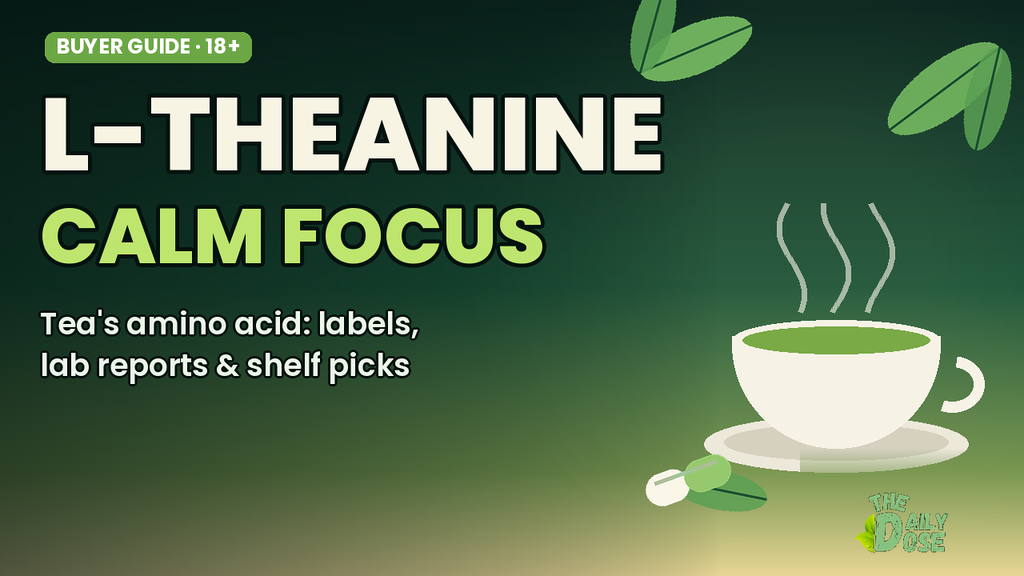
Every few weeks somebody walks up to the counter holding a bottle of our L-Theanine capsules and asks the same thing: “Mike, is this the tea stuff?” Yep. That’s the one. And honestly, an L-theanine supplement is one of the simplest products on our whole Stress Relief shelf, which is exactly why it’s worth a proper conversation. Simple products are easy to oversell.
We’ve touched on L-theanine before inside Best Nootropics for Focus: Calm Clarity vs Drive and Focus and Energy Supplements: Natural Options Beyond Coffee. Today it gets its own episode: what it is, where it comes from, how to read the milligrams on the label, why “L-” matters, what the research has looked at (and what it hasn’t), how it lines up next to coffee, rhodiola and ashwagandha, and the quality checks I want to see before a bottle goes on our shelf.
Quick ground rules before we get going. This is shopping education, not medical advice. These statements have not been evaluated by the FDA, and these products are not intended to diagnose, treat, cure, or prevent any disease. L-theanine products on our shelf are for adults 18+ only. Follow the directions on your label and don’t build your own serving plan from a blog post. If you are pregnant or nursing, take any medication (especially blood pressure medication, sedatives, sleep aids or stimulants), or have a health condition, talk with a qualified clinician first. Keep supplements away from children and pets. See our Product Warnings & Disclosures and Age Verification pages before you order.
Key Takeaways
- L-theanine is an amino acid found naturally in tea leaves. It is not an herb, a stimulant or a cannabinoid, and it is not one of the amino acids your body uses to build protein.
- Most supplements sell it as a single isolated ingredient, so the label should be easy to read: one ingredient, a milligram amount per capsule, and a capsule count.
- Look for “L-theanine” by name. Plain “theanine” can mean a mix of the L- and D- forms, and the L- form is the one found in tea and the one most research has used.
- Researchers have mostly studied L-theanine for relaxed alertness and calm focus, often alongside caffeine. Studies are generally small and short, so keep expectations realistic.
- Single-ingredient capsules and multi-ingredient focus blends are different products. In a blend, L-theanine is often inside a proprietary blend with no individual amount listed.
- Want a COA (lab report) that confirms identity and purity and screens for heavy metals and microbes. Talk to a clinician first if you take medications or are pregnant or nursing.
Table of Contents
- What Is L-Theanine?
- How L-Theanine Works (The Short Version)
- Tea vs an L-Theanine Supplement
- Reading the Label: Milligrams, L- vs DL-, and Forms
- What the Research Has Looked At
- L-Theanine and Caffeine: The Classic Pairing
- L-Theanine vs Rhodiola and Ashwagandha
- Quality Checks and Red Flags
- Who Should Be Careful
- Our Shelf Picks
- My Thoughts
- FAQ
What Is L-Theanine?
L-theanine is a naturally occurring amino acid found mainly in the leaves of the tea plant, Camellia sinensis. That’s the same plant behind green, black, oolong and white tea. Japanese researchers first identified it in tea leaves in the late 1940s, and it’s a big part of why good green tea has that savory, brothy “umami” note. Small amounts also show up in a few mushrooms, but tea is the main natural source.
Here’s the part that trips people up. L-theanine is an amino acid, but it’s a non-protein amino acid. Your body doesn’t use it as a building block for muscle the way it uses leucine or glycine. It’s closer to a tea compound that happens to be an amino acid by chemistry.
Shade-grown teas like gyokuro and matcha are known for carrying more L-theanine than sun-grown leaf, because shading changes how the plant handles its amino acids.
How supplement-grade L-theanine is made
Supplement L-theanine is not usually ground-up tea. Most of what’s sold is produced through fermentation or an enzymatic process that makes the same molecule found in tea, then purified into a white powder. Some brands use a branded, trademarked ingredient; others just say “L-theanine.” Either way, what you want on the label is the specific L- form and a clear milligram amount.
How L-Theanine Works (The Short Version)
Keeping this simple. L-theanine is able to cross from the bloodstream into the brain, and researchers have looked at how it interacts with brain chemistry tied to calm and attention, including GABA, glutamate, and the electrical patterns measured on an EEG.
The finding people quote most is the “alpha wave” one. In several small EEG studies, L-theanine was associated with increased alpha brain-wave activity, which researchers link to a state often described as relaxed but alert. That’s the lane L-theanine lives in.
What it is not: a sedative, a stimulant, or anything that should feel dramatic. If someone is selling you an L-theanine product with a promise of a big “hit,” that’s marketing, not chemistry. The structure/function language you’ll see on a compliant label is along the lines of “supports relaxation” or “supports calm focus,” and that’s the right way to think about it.
Tea vs an L-Theanine Supplement
So if tea has L-theanine, why buy a capsule? Two reasons: amount and caffeine.
The amount difference
A cup of tea contains a modest amount of L-theanine, and it varies a lot by tea type, leaf grade, water temperature and steep time. Published estimates for a regular cup usually land somewhere in the single digits to a few dozen milligrams. A supplement capsule, by comparison, commonly lists 100mg to 400mg per capsule. Our Root Organix capsules list 400mg per capsule. That’s a very different ballpark from your afternoon cup, which is exactly why you should read the label and follow the directions instead of treating capsules like tea.
The caffeine difference
Tea always comes with caffeine unless it’s decaffeinated. A single-ingredient L-theanine capsule doesn’t contain caffeine at all. For some shoppers, that’s the whole point: they want the tea compound without another stimulant in the day. For others, they like pairing it with their own coffee or tea. More on that below.
Reading the Label: Milligrams, L- vs DL-, and Forms
This is where an L-theanine supplement should shine, because a single-ingredient product has nowhere to hide. Here’s what I check, in order.
1. The exact ingredient name
Look for “L-theanine” spelled out. Theanine exists in two mirror-image forms, L- and D-. The L- form is the one tea plants make and the one most studies have used. Some cheaper synthetic material is a “DL” mix of both. If a label only says “theanine,” it’s fair to ask the brand which form it is.
2. Milligrams per capsule vs per serving
Labels list either an amount per capsule or an amount per serving (which may be two capsules). Those are not the same number. Read both, and read the capsule count, so you know what a bottle actually holds. Our Root Organix listing gives 400mg capsules in a 60ct bottle and asks you to follow the package directions.
3. Single ingredient vs blend
Single-ingredient L-theanine should list just that, plus the capsule shell and maybe a flow agent. In a multi-ingredient focus or sleep formula, L-theanine is often one item inside a “proprietary blend,” which means the brand lists the blend’s total weight but not how much L-theanine is in it. That’s legal, and it’s common, but it means you can’t compare those products milligram for milligram with a straight L-theanine capsule.
What the Research Has Looked At
Here’s the honest picture in plain language.
- Relaxed alertness: the most consistent theme in the research is that L-theanine is associated with a calm-but-alert state, often measured with EEG alpha waves and self-reported relaxation scores.
- Attention tasks with caffeine: a number of small studies have looked at L-theanine taken together with caffeine and measured performance on attention and task-switching tests. Several reported improvements versus placebo, though results vary.
- Everyday stress responses: some studies have looked at how people felt and how certain stress markers moved during a demanding task. Findings are mixed and generally modest.
- Sleep quality: L-theanine has also been studied for relaxation before bed and self-reported sleep quality. It isn’t a sedative, which is part of why it shows up in both “focus” and “sleep” products.
The caveats matter: many studies are small, short, and use different amounts, forms and populations, and a few are funded by ingredient makers. Nothing here means L-theanine treats any condition, and it’s no substitute for care from a clinician. If you’re dealing with ongoing stress, trouble sleeping or anything that’s affecting your life, please talk to a professional. A capsule is a supplement, not a plan.
L-Theanine and Caffeine: The Classic Pairing
If you’ve hung around the nootropics corner of the internet, you’ve heard of “caffeine plus L-theanine.” It’s probably the most famous stack out there, and it’s basically recreating what tea already does naturally: a little caffeine with a little theanine.
The idea people talk about is that L-theanine may smooth out the edges of caffeine, so the alertness feels steadier and less jittery. Some research supports the “calm focus” side of that picture, and plenty of shoppers describe it that way. But two practical notes:
- Count your total caffeine. L-theanine doesn’t cancel caffeine. If you add it to coffee, energy drinks, pre-workout and a caffeinated gummy, you’re still stacking caffeine. Read every label.
- Don’t freelance ratios from the internet. Follow each product’s directions, and if you take a stimulant medication or have a heart or blood pressure condition, ask your clinician before adding either one.
Our Focus & Energy shelf has both caffeine-free and caffeinated options, so check the supplement facts before you add anything to cart. If you want the bigger “calm clarity vs drive” breakdown, that’s what Best Nootropics for Focus is for.
L-Theanine vs Rhodiola and Ashwagandha
L-theanine lives on our Stress Relief shelf next to some very different products, including kava, which deserves its own episode. Here’s how I explain the differences at the counter.
L-theanine vs rhodiola
Rhodiola rosea is a cold-climate root sold as a standardized extract, usually with rosavin and salidroside percentages on the label. It’s an adaptogen, a plant with its own chemistry and its own medication cautions. L-theanine is a single amino acid. If you want the plant-and-percentages story, read Rhodiola Rosea: What Shoppers Should Know.
L-theanine vs ashwagandha
Ashwagandha is a root from Ayurvedic tradition, usually standardized for withanolides and generally used as a daily routine product rather than in the moment. It carries a longer list of cautions, including pregnancy and thyroid considerations. L-theanine is the simpler, more single-purpose ingredient of the two.
Bottom line: if you want one simple, tea-derived ingredient with an easy-to-read label, L-theanine is a sensible place to start learning. If you want a botanical, that’s a different shelf walk with its own cautions.
Quality Checks and Red Flags
A single-ingredient supplement makes quality checks easier, so hold the brand to it.
What I want to see
- A COA (certificate of analysis), ideally batch-matched, that confirms identity (that it really is L-theanine) and purity, often by HPLC.
- Contaminant screening: heavy metals (lead, arsenic, cadmium, mercury) and microbes (yeast, mold, bacteria).
- A clear label: “L-theanine,” milligrams per capsule, capsule count, shell type (vegan or gelatin), and a short other-ingredients list with no surprise fillers or allergens.
- Adult-use and clinician language in the warning section, plus the FDA disclaimer.
Red flags
- Disease or treatment claims (“cures,” “treats,” “replaces your medication”). Compliant supplements don’t make those.
- Just “theanine” with no L- and no lab report.
- Proprietary blends that hide every amount while promising big results.
- No brand contact, no batch or lot number, no expiration date.
For what it’s worth, our Root Organix L-Theanine listing has a COA image right in the product gallery. That’s the standard I like to see.
Who Should Be Careful
L-theanine has a long history in the food supply through tea, and it’s widely sold as a food and supplement ingredient. That doesn’t mean it’s right for everyone. Talk with a qualified clinician before using an L-theanine supplement if any of these apply:
- You’re pregnant or nursing. There isn’t enough research on supplement amounts in pregnancy or breastfeeding.
- You take blood pressure medication. L-theanine has been studied for effects on blood pressure, so ask whether it fits with your medication.
- You take sedatives, sleep medications, or stimulants, including prescription focus medication. Combining calming or stimulating products deserves a professional’s eye.
- You’re stacking supplements. Many sleep and focus formulas already contain L-theanine. Check every label so you don’t double up without realizing it.
- You have any ongoing health condition or a scheduled surgery.
General common sense applies too: adults 18+ only, follow the label, don’t drive or operate machinery until you know how a new product affects you, keep it away from kids and pets, and stop using it and check with your clinician if anything feels off.
Our Shelf Picks
Here’s how I’d walk you through it. No prices in this post, because they drift. Check the product page for current details.
Primary: single-ingredient L-theanine capsules
Root Organix L-Theanine Capsules (60ct): 100% natural L-theanine in 400mg capsules with a vegan capsule shell, 60ct bottle, and a COA image in the gallery. Adults 18+. This is the product this guide is built around, and its listing sits in our calm focus, relaxation and energy support lane. Follow the directions on the package.
If you want L-theanine inside a focus blend
Herba Essentia Alpha Brain Focus Capsules: a 60ct focus and energy support capsule that lists L-theanine inside its “Flow Blend” along with L-tyrosine, oat extract and cat’s claw extract, plus a separate focus blend with Alpha GPC and bacopa. The L-theanine amount isn’t broken out on its own, so this is a “blend” buy, not a straight L-theanine buy. Adults 18+. Read the full supplement facts on the listing first.
Browse the shelves
- Stress Relief: where L-theanine sits alongside rhodiola, ashwagandha, kava and more.
- Focus & Energy: for blends and caffeinated options. Check each label for caffeine.
My Thoughts
I’ll be straight with you. L-theanine is one of my favorite products to explain because it’s so refreshingly boring, in a good way. One ingredient. One number on the label. A tea compound people have been drinking for centuries. There’s no mystery root, no “ancient secret,” and no reason to oversell it.
Where I see people go wrong is expectations. They read a headline about “calm focus” and expect a dramatic switch to flip. That’s not what this is. If L-theanine fits you, it’s more like a quieter background. If you want something you can really feel, I’d rather you slow down and talk to a clinician than chase a stronger product.
And please, read your labels. The number of people I talk to who are taking L-theanine in a sleep gummy, a focus capsule and a straight capsule at the same time, without realizing it, is higher than you’d think. A single-ingredient L-theanine supplement with a COA makes your routine easier to understand, and that’s the real win.
FAQ
What is an L-theanine supplement?
It’s a dietary supplement that provides L-theanine, an amino acid found naturally in tea leaves, usually in capsule form at a stated milligram amount. Single-ingredient products contain just L-theanine plus a capsule shell.
Does L-theanine contain caffeine?
No. L-theanine itself is not caffeine, and single-ingredient L-theanine capsules are caffeine-free. Tea contains both, and some focus blends add caffeine, so check the label of any multi-ingredient product.
Will L-theanine make me sleepy?
L-theanine is not a sedative, and research has mostly looked at it for a relaxed-but-alert state. Everyone is different, so don’t drive or operate machinery until you know how a new product affects you.
How much L-theanine is in a capsule?
It depends on the brand. Labels commonly list 100mg to 400mg per capsule. Root Organix lists 400mg per capsule. Follow the directions on your package, and ask a clinician before changing how you use it.
Can I take L-theanine with coffee?
Many people do, and the caffeine-plus-L-theanine pairing has been studied. L-theanine does not cancel caffeine, so count your total caffeine from every source, and talk to a clinician if you take a stimulant medication or have a heart or blood pressure concern.
Soft Disclaimer
This article is for educational shopping purposes only and is not medical advice. L-theanine supplements are not intended to diagnose, treat, cure, or prevent any disease, and these statements have not been evaluated by the FDA. For adults 18+ only. Follow the product label, keep supplements away from children and pets, and consult a qualified healthcare professional before use if you are pregnant or nursing, take any medication, or have a medical condition. See our Product Warnings & Disclosures and Age Verification pages for more.
Want more practical guides from the calm-focus lane? Check out Rhodiola Rosea: What Shoppers Should Know, Best Nootropics for Focus, and Focus and Energy Supplements, and catch the next episode of The Daily Dose Podcast.