To listen to the full audio episode checkout The Daily Dose Podcast Audio
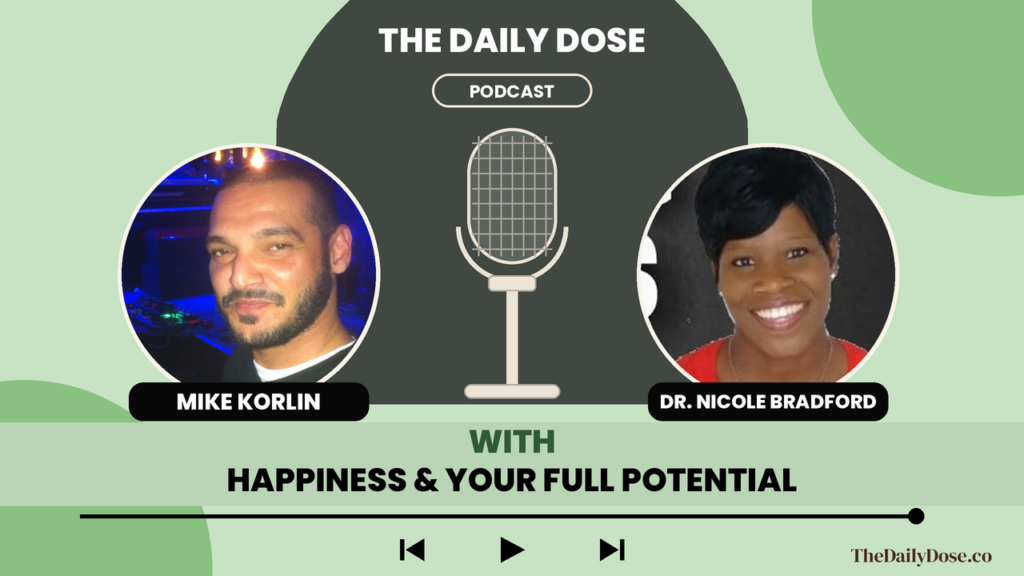
Do you ever wonder what happened to the spark you had as a kid? That feeling of possibility and excitement that ran through you every day. If so, you are not alone. I have wondered the same thing, and in this episode of The Daily Dose Podcast I talk about it with Dr. Nicole Bradford.
Our conversation is about happiness and fulfillment: what they actually mean to you, how to get back to that sense of endless possibility, and why mental health is such a big hurdle for so many people right now. This is a conversation about perspective and self-discovery, not medical advice.
Key Takeaways
- Dr. Nicole Bradford joins Mike Korlin to talk about happiness, fulfillment, and what it means to come into this world with nothing and make life exciting, fun, and fulfilling.
- Happiness and fulfillment can mean something different to each person, and self-discovery helps you define what they mean for you.
- We talk about the struggles of young adults and the burdens adults carry, including the many masks we wear from one situation to the next.
- Mental health is described as a major challenge, and the post cites Mental Health America (MHA) data to show the scale.
- Stigma, early support, and healthy routines come up as important parts of long-term well-being.
- If you are struggling, a qualified mental health professional is the right place to start.
Table of Contents
- Meet the Guest: Dr. Nicole Bradford
- Rediscovering That Childhood Spark
- Defining Happiness and Fulfillment
- The State of Mental Health Today
- Finding Support Without the Stigma
- FAQ
- Educational Disclaimer
Meet the Guest: Dr. Nicole Bradford
Dr. Nicole Bradford is the guest on this episode. Together we get into what it takes to find your purpose and live fully. Dr. Bradford and I discuss in great length the struggles of young adults and the burdens adults face today as we navigate the many masks we wear day to day and from person to person.
Rediscovering That Childhood Spark
I am not perfect. I too have had times with depression, anxiety, and stress, and I worry about an uncertain future like anyone else. What helps me is to return, as often as I can, to the mindset I had as a kid: endless possibilities and a belief that I could achieve whatever I set my mind to.
When you do that, you may discover yourself, perhaps for the very first time. As you learn about that part of your being, you can begin to define happiness and what fulfillment means to you. This is a big part of what Dr. Bradford and I explore in the episode.
Defining Happiness and Fulfillment
The world keeps readjusting to shifting narratives of what is true and what is not, and that can leave people feeling unsure of themselves. Here is how I think about building a clearer picture of what you want:
- Ask what fulfillment means to you, not to your family, your job, or social media.
- Notice the masks you wear, and think about which parts of your life feel most like the real you.
- Make room for curiosity, like you had as a child.
- Keep learning about yourself. Self-discovery is ongoing, not a one-time project.
The State of Mental Health Today
At this moment in history, the numbers around mental illness are alarming, with some estimates running as high as 20 percent of the population depending on the age group. In the post I referenced Mental Health America (MHA), a nonprofit that was founded in 1909 by Clifford W. Beers and describes itself as the nation’s leading community-based nonprofit dedicated to the needs of people living with mental illness. These are the key findings I cited from MHA’s 2022 report:
- In 2019-2020, 20.78% of adults were experiencing a mental illness, equivalent to over 50 million Americans.
- 15.35% of adults had a substance use disorder in the past year, and of those, 93.5% did not receive any form of treatment.
- 4.84% of adults reported serious thoughts of suicide, totaling over 12.1 million people. Among adults who identified with two or more races, the rate was 11%, which is 6% higher than the average among all adults.
You can find more on these stats at Mental Health America. If you or someone you know is thinking about suicide or is in crisis, please call or text 988 in the U.S. (the Suicide and Crisis Lifeline) or contact local emergency services right away.
Finding Support Without the Stigma
Stigma keeps a lot of people quiet. In the post, I talked about how stereotypes and negative attitudes can lead people to worry about being judged, which makes them less likely to talk about what they are going through. Open, compassionate conversation helps break that cycle.
Some general ideas that come up in this kind of conversation:
- Regular self-care, such as movement, rest, meditation, and hobbies.
- Social connection, meaning relationships with people who give you empathy and joy.
- Continuous learning, trying new things to keep growing.
- Mindfulness, which can help with present-moment awareness and stress.
- Professional support, like therapy or counseling, as a tool for navigating life’s challenges.
If you want to keep exploring mental health on The Daily Dose Podcast, check out The Therapy Twins on mental health treatment and Kyle Lynch on mental health and self-discovery.
FAQ
Stigma can make people afraid of being judged, which may keep them from seeking help or even talking about what they are going through. It can also add to shame and isolation. More compassionate, open conversations help reduce that barrier.
Self-discovery means exploring your values, strengths, desires, and limits. It can help you make choices that fit who you are, and understanding your emotional needs is an important part of caring for yourself.
Reaching out earlier can make it easier to learn coping strategies and get support before challenges grow. It also helps normalize asking for help.
Learning about mental health, talking with a trusted friend or family member, and reaching out to a mental health professional are all common first steps. Reading or listening to other people’s stories can also help you feel less alone.
Self-care, social connection, continued learning, mindfulness, and professional support when needed are all mentioned in this post. Individual needs differ, so a qualified professional can help you find what suits you.
Educational Disclaimer
This article is for educational and informational purposes only and reflects a podcast conversation. It is not medical or mental health advice and is not a substitute for professional care. If you are struggling, please contact a licensed mental health professional. If you are in crisis, call or text 988 in the U.S. or local emergency services.
Related Articles:
- The State Of Mental Health Treatment: The Therapy Twins
- Psilocybin Is Making Break Throughs: Mental Health
- Mental Health And Self Discovery Kyle Lynch
- Mental Health Potential of Plant Medicines
- Magic Mushrooms For Mental Health Explained
Meet The Author