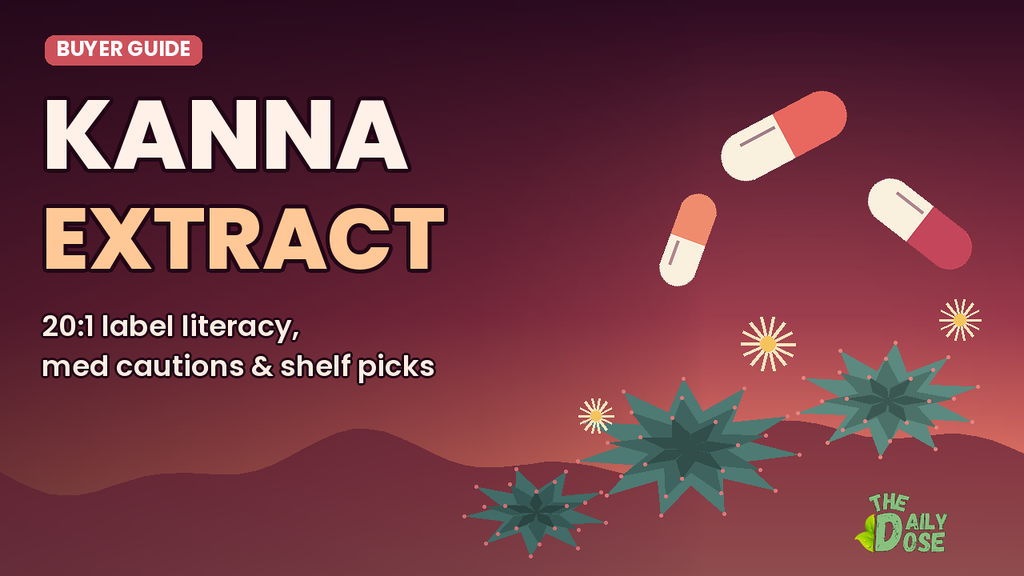
If you’ve been browsing our Mood Lifters shelf and stopped on a bottle labeled kanna extract, you probably had the same reaction a lot of listeners do: “Wait, what plant is that, and is it the same thing as kratom?” Kanna is one of the most-asked-about botanicals we carry, and one of the least understood.
So this guide keeps it practical: what kanna is, how capsules compare to other formats, what a “20:1” ratio actually tells you, the quality checks I want to see, how kanna differs from kratom, who should be careful, and where our live SKU sits on the shelf. For a wider calm-and-mood reading list, pair it with Blue Lotus Extract: What Shoppers Should Know and Ashwagandha for Stress: What Shoppers Should Know. This is shopping education, not medical advice.
Quick ground rules: these statements have not been evaluated by the FDA, and these products are not intended to diagnose, treat, cure, or prevent any disease. Kanna products on our shelf are for adults only (18+). Follow the label, start at the low end of its range, and don’t build your own serving plan from a blog post. If you take any medication (especially antidepressants or other mood medications), are pregnant or nursing, or have a health condition, talk with a qualified clinician first. Keep products away from children and pets. Check our Product Warnings & Disclosures and your local rules before ordering.
Key Takeaways
- Kanna extract is a concentrated form of Sceletium tortuosum, a low-growing succulent from southern Africa. On our shelf it comes as a 20:1 extract in 500mg capsules.
- Kanna is not kratom and not blue lotus. Different plants, different families, different labels. Don’t shop them as substitutes.
- An extract ratio like 20:1 describes how much raw plant went into the extract. It is not an alkaloid percentage, and it doesn’t guarantee strength by itself.
- Standardized extracts state a measured alkaloid percentage (often mesembrine or total alkaloids). If a label gives both a ratio and a standardization, the standardization is the more specific number.
- Quality shopping means a batch-matched COA, identity testing, and contaminants (heavy metals, microbes) reported, not just “lab tested” on the bottle.
- The big safety note: talk to a clinician before mixing kanna with antidepressants or other mood or serotonin-related medications or supplements. Adults only, follow the label, start low.
Table of Contents
- What Is Kanna Extract?
- Where Does Kanna Come From?
- Kanna Capsules vs Powders, Tinctures, and Other Formats
- What Does 20:1 Mean on a Kanna Label?
- How Do You Check Kanna Quality?
- Is Kanna the Same as Kratom?
- Who Should Be Careful With Kanna?
- How Do Shoppers Typically Use Kanna Capsules?
- Our Shelf Picks
- My Thoughts
- FAQ
What Is Kanna Extract?
Kanna is the common name for Sceletium tortuosum, a small succulent plant in the ice plant family (Aizoaceae). It grows in dry regions of southern Africa, and you’ll sometimes see it called “Sceletium,” “kougoed,” or “channa” on labels and in older writing.
An extract is what you get when dried plant material is processed to concentrate certain compounds and leave bulk plant matter behind. With kanna, the compounds people talk about are a group of alkaloids, with mesembrine usually named first, plus relatives like mesembrenone. You’ll see those names on COAs. They’re chemistry vocabulary, not a promise about how anyone will feel.
In shopping terms, there are three broad kinds of kanna product you’ll run into:
- Raw or dried plant material (cut, powdered, or traditionally fermented), the least concentrated form.
- Ratio extracts (5:1, 20:1, 50:1, and up), labeled by how much plant went into the extract.
- Standardized extracts, labeled with a measured alkaloid percentage.
On our shelf, the live SKU is Root Organix Kanna Capsules in the Mood Lifters category. The listing describes pure kanna at a 20:1 extract ratio in 500mg capsules, available in 60ct and 120ct bottles, with a COA image in the product gallery. Adults 18+ only.
Where Does Kanna Come From?
Kanna has a long history with Indigenous San and Khoikhoi communities in what is now South Africa. Traditional preparation often involved crushing the plant and letting it ferment before chewing it or making a tea. Dutch colonial records from the 1600s mention it too.
That history is useful context, and it’s why brands lean on the word “traditional.” But cultural history is not clinical evidence, and I’m not going to sell you a heritage story as proof of anything. Researchers have studied kanna’s alkaloids, including some small human trials on standardized extracts, but the research is still limited. Sourcing-wise, most commercial kanna is described as cultivated. A brand that tells you where its plant comes from is a good sign; “ancient African secret” and nothing else is not.
Kanna Capsules vs Powders, Tinctures, and Other Formats
Capsules
Kanna capsules are the simplest place to start for most shoppers. They’re pre-measured, so you don’t need a scale, and the label tells you the fill (on ours, 500mg of 20:1 extract per capsule) and the serving size. Pros: consistent portions, no taste, easy to read. Cons: you’re trusting the fill weight and extract quality, which is why the COA matters. Capsules are the format our shelf carries for kanna right now.
Powders
Kanna powders come in two very different types: plain dried plant powder and concentrated extract powder. A gram of one is not the same shopping decision as a gram of the other, and high-ratio powders usually need a milligram scale to portion. If you’re not set up to weigh small amounts, capsules remove that guesswork. We don’t carry a kanna powder SKU right now; I’m explaining the format so you know what ads are selling.
Tinctures, sprays, and lozenges
Tinctures, sprays, lozenges, and chewables combine an extract with a carrier (alcohol, glycerin, or a sweet base), and per-serving amounts are harder to compare. Look for extract type and amount per serving, not just “kanna” on the front.
Blends
Multi-ingredient “mood” or “calm” blends sometimes include kanna. That’s a different product from single-ingredient kanna, and if a proprietary blend hides how much kanna is inside, you can’t really compare it.
Bottom line for format shopping: if you want the simplest, most label-readable experience, single-ingredient kanna capsules are the lane. If you go powder or liquid, plan to read the label more carefully, and possibly to weigh.
What Does 20:1 Mean on a Kanna Label?
Ratio extracts
An extract ratio like 20:1 describes the manufacturing input. Roughly, about 20 parts of dried plant material were used to produce 1 part of extract. A bigger first number means the extract is more concentrated relative to the starting plant.
What a ratio does not tell you:
- The actual alkaloid percentage in the finished extract
- How much mesembrine (or any single alkaloid) is in each capsule
- How the starting plant material varied from harvest to harvest
- Whether a carrier was added during drying
Two 20:1 extracts from different suppliers or batches can differ, because the plant itself varies. A ratio is a concentration signal, not a verified potency number.
Standardized extracts
A standardized extract is made and tested to hit a stated percentage of one or more measured compounds, such as “X% total alkaloids” or “X% mesembrine.” Labs typically measure those with HPLC (high-performance liquid chromatography). When a product lists both a ratio and a standardization, the standardization is the more specific, more comparable number.
How I read a kanna label
- Ratio only? Treat it as a concentration signal. Follow the label and start low.
- Standardized? Note the compound and the percentage, and check that the COA reports the same thing.
- Bigger ratio isn’t automatically “better.” It mostly means less material per serving, so accurate portioning matters more.
- Don’t compare brands on ratio alone. Compare extract type, amount per serving, and testing.
How Do You Check Kanna Quality?
Niche botanicals attract loosely documented product. Testing paperwork is part of what you’re buying.
What I want to see
- Batch-matched COA: the lot number on your bottle should match the lot on the certificate.
- Identity testing: confirmation that the material really is Sceletium tortuosum, ideally with an alkaloid profile by HPLC.
- Named laboratory: a real lab name and report date, not just “third-party tested.”
- Contaminant panel: heavy metals (lead, arsenic, cadmium, mercury) with numbers, plus microbial screening.
- Clear supplement facts: extract type, ratio or standardization, mg per capsule, and serving size.
Red flags
- Huge ratios (200:1 and up) with no alkaloid data and no COA
- Proprietary blends that hide how much kanna is in each serving
- Storefront promises that it fixes a medical or mental health condition, or replaces medication. Walk away; that’s marketing, not quality control.
- No lot number on the bottle
Our listing shows a COA image in the product gallery. Same advice for our bottle as anyone’s: open the COA, check the lot and date, and see which tests it covers.
Is Kanna the Same as Kratom?
No. It’s the most common mix-up I hear, probably because the names sound alike.
- Kanna (Sceletium tortuosum) is a small succulent from southern Africa. Its alkaloids are the mesembrine family.
- Kratom (Mitragyna speciosa) is a tropical tree in the coffee family from Southeast Asia. Its alkaloids are mitragynine and relatives, with their own safety and legal considerations. For that lane, start with Kratom Strains Explained: Red vs Green vs White.
- Blue lotus (Nymphaea caerulea) is a water lily with different chemistry again. Our blue lotus buyer guide covers it.
They aren’t interchangeable, and I’d never suggest swapping or stacking them to “see what happens.”
Who Should Be Careful With Kanna?
Natural doesn’t mean risk-free. The cautions I’d put front and center:
- Medications, especially antidepressants. Researchers have studied how kanna’s alkaloids interact with serotonin-related pathways. That’s exactly why combining kanna with SSRIs, SNRIs, MAOIs, other antidepressants, or other mood medications is a conversation for your prescriber, not a blog. Our listing says the same: talk to a healthcare professional first if you take medication, especially antidepressant medication.
- Other serotonin-related supplements. Don’t stack kanna with things like 5-HTP or St. John’s wort on your own. One new product at a time, and ask a clinician about combinations.
- Pregnancy and nursing. There isn’t good safety data. Skip it unless your clinician says otherwise.
- Health conditions. If you have any medical or mental health condition, check with your clinician before trying a new botanical.
- Under 18. Not for minors. Our kanna listing is adults 18+ only.
And the basics: don’t mix with alcohol, don’t drive until you know how a new product affects you, and stop and get advice if something feels off. Kanna is not a substitute for mental health care. If you’re struggling, please reach out to a professional. That matters more than anything on our shelf.
How Do Shoppers Typically Use Kanna Capsules?
Label first. Always.
Our listing for the Root Organix kanna capsules shows 500mg capsules of 20:1 extract and tells you to follow the directions on the label. I don’t give personal serving plans in blog posts: follow the label and start low.
Practical habits I hear from careful shoppers (always subordinate to the bottle and your clinician):
- Start at the low end of what the label allows.
- Change one variable at a time; don’t start several new products the same week.
- Store the bottle sealed, cool, and dry, away from kids and pets.
- If you’re on any medication, have the clinician conversation before the first capsule, not after.
If the label and a blog disagree, the label wins. If you’re unsure because of medications or a condition, a clinician wins over both.
Our Shelf Picks
Here’s how I’d line this up on a shelf walk. No live prices, because they drift.
Primary: single-ingredient kanna capsules
Root Organix Kanna Capsules (60ct or 120ct): pure kanna, 20:1 extract ratio, 500mg capsules, supplement facts on the label, COA image in the gallery. Adults 18+. This is the SKU this buyer guide is built around.
Browse the full category: Mood Lifters.
Related shelf neighbors (read each label on its own terms)
- Root Organix L-Theanine Capsules: an amino acid found naturally in tea, 400mg vegan capsules. A different shopping lane that calm-and-focus shoppers often compare.
- PHORIA Blue Lotus Extract Capsules: a 200:1 water lily extract in 500mg capsules. A different plant entirely; see the blue lotus guide above.
- Calm Zen Rhodiola Rosea Extract Capsules: a standardized adaptogen extract (3% rosavins, 1% salidroside), and a good example of what a standardized label looks like.
- Root Organix Ashwagandha Root Capsules: an Ayurvedic-tradition root powder capsule from the Stress Relief shelf.
More calm-lane browsing: Stress Relief. None of these replace reading warnings. Link-hopping is research, not a stack plan.
My Thoughts
I’ll be honest with you. When I first started carrying kanna extract, I had to do the same homework I’m asking you to do. The name gets confused with kratom constantly, and most pages online sell giant ratios without explaining what the numbers mean.
What I’ve landed on is pretty simple. I like kanna in a single-ingredient capsule because it’s the most readable version of the product: one plant, one extract ratio, a clear mg per capsule, and a COA you can look at. That’s why our Root Organix 20:1 capsules are the SKU on the shelf, instead of a mystery “mood blend” with a hidden amount of kanna inside.
The other thing I keep coming back to is the medication conversation. If you’re on an antidepressant or any mood medication, talk to your prescriber first. That’s not me being dramatic; it’s what our listing says too.
Do the boring parts (format, ratio literacy, COA, the clinician check) and you’ll be a better-informed shopper than most of the internet. None of this is a diagnosis tool or a treatment plan. It’s a bottle on a shelf, and your clinician still outranks my podcast.
FAQ
What is kanna made from?
Kanna comes from Sceletium tortuosum, a succulent plant native to southern Africa. Kanna extracts concentrate the plant’s alkaloids, such as mesembrine, from dried plant material.
What does 20:1 mean on kanna capsules?
Roughly 20 parts of dried plant were used to make 1 part of extract. It’s a concentration signal, not a measured alkaloid percentage.
Are standardized kanna extracts better than ratio extracts?
Not “better,” just more specific: they state a measured alkaloid percentage. A clearly labeled, tested ratio extract can still be a good product.
Is kanna the same as kratom?
No. Kanna is a southern African succulent; kratom is a Southeast Asian tree in the coffee family. Different plants, different alkaloids, different labels.
Can I take kanna with antidepressants or other supplements?
Don’t do it without your prescriber’s okay. Kanna’s alkaloids have been studied for activity on serotonin-related pathways, so combinations with antidepressants, other mood medications, or supplements like 5-HTP need a clinician’s input first.
Where can I buy kanna extract?
On our shop, the live SKU is Root Organix Kanna Capsules in the Mood Lifters category. Wherever you buy, look for a batch-matched COA, clear supplement facts, and adults-only sales.
How should I take kanna capsules?
Follow the label and start low. I don’t give personal dosing plans in blog posts, and if you take any medication, check with your prescriber first.
Soft Disclaimer
This article is for educational shopping purposes only and is not medical or legal advice. These statements have not been evaluated by the FDA, and these products are not intended to diagnose, treat, cure, or prevent any disease. For adults 18+ only. Follow the label, start at the low end of the label range, keep products away from children and pets, and consult a qualified healthcare professional before use if you are pregnant or nursing, take any medication (especially antidepressants or other mood medications), or have a medical condition. Check your local rules before ordering. See our Product Warnings & Disclosures for more.
Want more practical botanical guides? Check out Blue Lotus Extract, Ashwagandha for Stress, Best Nootropics for Focus, and Shilajit Resin, and catch the next episode of The Daily Dose Podcast.