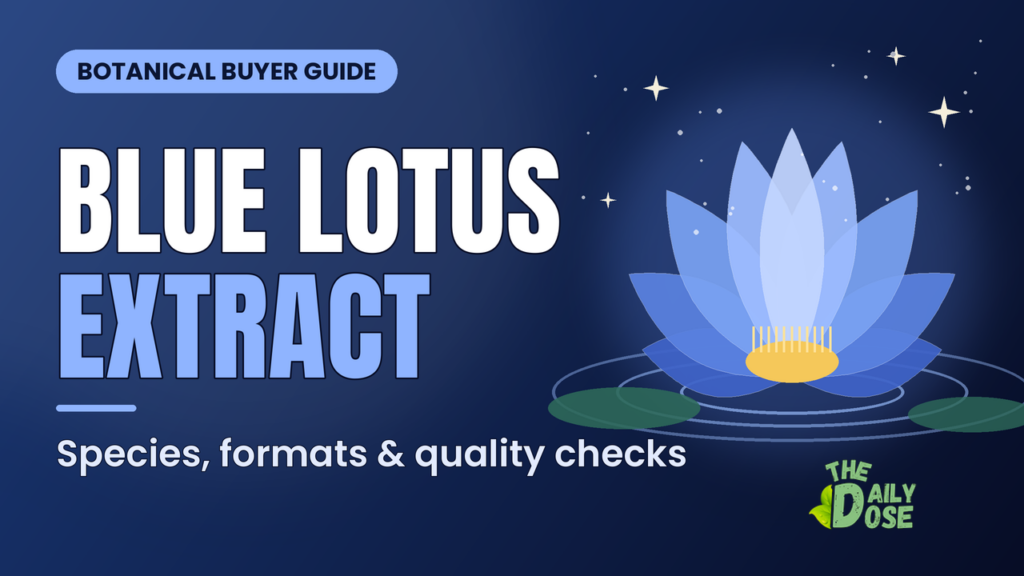
If you have spent any time on The Daily Dose podcast, you know I like botanicals that come with a real story — and few plants carry more story than the blue lotus, the flower behind every jar of blue lotus extract. From Egyptian tomb art to modern evening teas, it shows up everywhere.
Lately the question in my inbox sounds like this: “Mike, what exactly is blue lotus extract, how is it different from the flower or the tea, and how do I know I am buying the real thing?” Great question. Common names overlap, extract ratios look impressive without telling you much, and formats range from dried petals to disposable vapes.
Today I will walk you through what blue lotus actually is, how extracts differ from flower and tea, what to check on a label and a certificate of analysis (COA), some high-level legal notes, and how the live picks on our shelf compare. Building a calmer evening routine with other botanicals? See Ashwagandha for Stress and Kava for Anxiety and Stress. Want daytime clarity instead of wind-down? Start with Best Nootropics for Focus.
This is educational shopping guidance, not medical advice. These products are not intended to diagnose, treat, cure, or prevent any disease, and these statements have not been evaluated by the FDA. Blue lotus products are for adults (18+). Start low. One change at a time. Keep products away from kids and pets. Rules vary by state and country — check our Product Warnings & Disclosures and your local law before you order. Talk with a qualified clinician first if you are pregnant or nursing, take medications, or have any health condition.
Key Takeaways
- Blue lotus extract should come from Nymphaea caerulea — the Egyptian blue lotus, botanically a water lily. It is not the same plant as pink or sacred lotus (Nelumbo nucifera).
- Extract ratios like 200:1 describe how much raw flower went into the concentrate. That is a manufacturing claim, not a measured potency or a promise of how you will feel.
- Formats behave differently: dried blue lotus flower and blue lotus tea are the gentlest, most traditional route; powders and capsules are concentrated; a blue lotus vape is an adult inhale product, often blended with other ingredients.
- Shop for a species name, a batch-matched third-party COA, and a full ingredient list. “Proprietary blend” with no numbers gives you less to go on.
- Nuciferine and aporphine are the compounds most commonly discussed with blue lotus. That is chemistry talk, not a health claim.
- Legal status is not uniform. Louisiana, for example, lists Nymphaea caerulea as a prohibited plant for consumable uses. Always check local rules.
Table of Contents
- What Is Blue Lotus (Nymphaea caerulea)?
- Species ID: Blue Lotus vs Pink Lotus vs Mislabeled Products
- Blue Lotus Formats: Extract, Flower, Tea, Capsule, Vape
- What “200:1” Actually Means
- Quality Checks: COAs, Testing, and Adulteration
- Legal and Shipping Notes (High Level)
- Our Shelf Picks Compared
- How to Shop Blue Lotus Responsibly
- My Thoughts
- FAQ
What Is Blue Lotus (Nymphaea caerulea)?
When I say blue lotus on the show, I mean Nymphaea caerulea, a water lily native to the Nile region and parts of East Africa. You will see it sold as Egyptian blue lotus, blue water lily, or sacred blue lily. The flowers open in the morning and close in the afternoon, which is part of why ancient Egyptian art connects them with the sun and renewal.
Modern shoppers mostly meet it three ways: dried flowers for tea, concentrated extracts (powders and capsules), and aromatic inhale products. It is usually marketed in the relaxation and mood aisle — the evening wind-down, the meditation corner. My frame: blue lotus is a traditional botanical with a long cultural history and limited modern research. History tells you people have valued the plant for a very long time. It does not tell you a specific product will do a specific thing for you.
The compounds people talk about
Read about blue lotus for five minutes and you will run into nuciferine and aporphine — alkaloids commonly discussed when people describe the plant’s profile. I keep this strictly educational: compound names on a product page are not proof of an effect, and alkaloid content can vary by plant part, growing conditions, and processing. Most retail labels do not list measured alkaloid amounts at all, which is one more reason the COA conversation matters.
Species ID: Blue Lotus vs Pink Lotus vs Mislabeled Products
The word “lotus” covers several different plants in the botanical trade:
- Blue lotus — Nymphaea caerulea: The Egyptian blue water lily. This is the plant blue lotus extracts are supposed to come from.
- Pink or sacred lotus — Nelumbo nucifera: A different genus, common in Asian cooking and tradition. Pink lotus products also mention nuciferine (the name comes from nucifera), which adds to the confusion.
- White Egyptian lotus — Nymphaea lotus: A close cousin, sometimes blended or swapped in the dried-flower trade.
A bag that just says “lotus” could be any of these, and petal color is not reliable once something has been processed or powdered. My checklist:
- Latin name — “Nymphaea caerulea” on the label or product page.
- Plant part — Flower, petals, or whole plant. They are not identical.
- Identity testing — Better suppliers run botanical identity checks and can say so on request.
- Skip vague “lotus” blends — If a brand will not tell you which lotus, you cannot compare it to anything.
Blue Lotus Formats: Extract, Flower, Tea, Capsule, Vape
Dried blue lotus flower and blue lotus tea
The most traditional route. Dried blue lotus flower petals are steeped as an herbal tea, sometimes with citrus or honey. Blue lotus tea is mild and floral — the most ritual, the least concentration, and the easiest way to go slow. Tradeoff: dried flowers vary batch to batch.
Powdered blue lotus extract
A powdered blue lotus extract is the flower concentrated down, usually labeled with a ratio such as 20:1 or 200:1. Powders let you measure small servings and mix into tea or a drink. They are far more concentrated than dried flower by weight, so “a pinch” of extract is not “a pinch” of petals. Start with the smallest serving the label suggests, or less.
Blue lotus capsules
Capsules pre-measure the same kind of extract — the simplest format for tracking what you took and when, same reason I like capsules in the ashwagandha aisle. Read milligrams per capsule and the serving size on the facts panel.
Blue lotus vape
A blue lotus vape is an adult inhale product, typically a disposable pen with blue lotus extract plus carriers and terpenes, and sometimes hemp. These are the format where you know the least about exact amounts unless the brand publishes them. Not for shoppers who do not already use inhale products. Do not drive or operate machinery if you feel any effect.
My quick rule: tea for ritual, capsules for measuring, powder for flexibility, vape only if you already want an inhale format.
What “200:1” Actually Means
A 200:1 ratio means the manufacturer reports using roughly 200 units of raw plant material to make 1 unit of extract. That is a statement about the process. It is not:
- A measured amount of any compound, like nuciferine.
- Proof a 200:1 product is “ten times stronger” than another brand’s 20:1 — solvents, starting material, and plant parts all differ.
- A standardization claim. “Standardized to X%” is a more specific claim and should show up on the COA.
Treat the ratio as one data point. Pair it with serving size, species name, and lab paperwork.
Quality Checks: COAs, Testing, and Adulteration
No scare segment here — but across the botanical industry, trendy plants attract shortcuts: mislabeled species, filler-heavy powders, occasionally undisclosed added ingredients. The answer is not panic. It is paperwork.
- Batch match — The COA should match the lot you receive and be reasonably recent.
- Third-party lab — An independent lab, not just an in-house sheet.
- Identity — Confirmation the material is Nymphaea caerulea.
- Contaminants — Heavy metals, microbials, and residual solvents for extracts. Water plants can pick up whatever is in their water, so heavy metals are worth asking about.
- Full disclosure — Especially for vapes and blends. If a blend includes hemp, ask for cannabinoid results too.
Red flags I walk past: no species name, no lot number, no test results on request, and marketing that promises dramatic results.
Legal and Shipping Notes (High Level)
I am not a lawyer and this is not legal advice — but blue lotus is not treated the same everywhere.
- United States — Blue lotus is not federally scheduled, and it is not an FDA-approved drug. Products are sold as botanicals or supplements.
- Louisiana — State law lists Nymphaea caerulea (Blue Lotus, Egyptian Lotus) among prohibited plants for products meant for consumption, smoking, or inhalation, with exceptions for ornamental or landscaping use. Do not assume a product can ship there.
- Elsewhere — Some countries restrict blue lotus, and rules change. Check local law before ordering, and re-check if you move or travel.
- Vapes and hemp blends — Inhale and hemp products can carry their own age, shipping, and state rules.
Shipping restrictions and warnings live on our Product Warnings & Disclosures page — please read it before checkout.
Our Shelf Picks Compared
These are live product pages checked for this guide, with details as they appear today. Product pages may use broader marketing language than I use here; this article sticks to shopping facts — format, size, ingredients — not health claims.
Powder pick — Phoria Naturals Blue Lotus Extract Relax Powder
Blue Lotus Extract Relax Powder by Phoria Naturals lists Pure Blue Lotus 200:1 Extract (Nymphaea caerulea) in a 60g powder. This is the flexible-format option: measure small servings and stir into tea or a drink. It is a high-ratio concentrate, so start very small, keep notes, and do not stack it with other relaxation botanicals on day one. Read the 18+, pregnancy/nursing, and medication warnings on the page.
Capsule option — Phoria Blue Lotus Extract Capsules
Prefer to skip scoops? Blue Lotus Extract Capsules by Phoria lists 200:1 blue lotus extract in 500mg capsules, in 60ct or 120ct bottles — same extract style, pre-measured.
Vape pick — Dope Boyz Blue Lotus Extract Vape 2g
Blue Lotus Extract Vape 2g by Dope Boyz is a disposable listed at 2.2g with a proprietary blend of blue lotus extract, hemp, and terpenes; the brand estimates roughly 300 puffs. Pick your flavor from the add-to-cart menu when you order. Adults 18+ who already use inhale formats only. Because it is a proprietary blend that includes hemp, ask for test results if exact composition matters to you.
Related mood-aisle botanicals (not blue lotus)
Blue lotus shoppers often also browse Root Organix Kanna Capsules (Sceletium tortuosum, 500mg capsules, 20:1 extract, 60ct or 120ct). Don’t combine kanna with 5-HTP, St. John’s wort or serotonergic medications; talk to a prescriber. Do not start several new mood-aisle products at once. The full aisle lives at Mood Lifters. For label checks before you buy kanna, see our kanna extract buyer’s guide.
How to Shop Blue Lotus Responsibly
- Species first — Nymphaea caerulea on the label. No species, no sale.
- Format that fits your life — Tea for ritual, capsules for routines, powder for flexibility, vape only if you already use inhale products.
- Serving size over ratio — The facts panel tells you how much is in a serving.
- COA check — Batch-matched, third-party, identity plus contaminants.
- Start low, one change at a time — Try it on a quiet evening at home, not before driving or work. Skip alcohol and other relaxation products while you learn how you respond. If you are also curious about cannabinoids, read Full Spectrum vs Broad Spectrum vs Isolate CBD or CBD Gummies with Melatonin and try things separately.
- Local rules — Especially Louisiana shoppers; check warnings & disclosures.
- Clinician check — If you are pregnant or nursing, take medications, or have any health condition.
My Thoughts
Honestly, blue lotus fascinates me more for its history than its hype. A flower that opens with the sunrise on a Nile pond and ends up painted on tomb walls thousands of years later. When I brew blue lotus tea, it feels more like a ritual than a supplement: a quiet cup, phone down, end of the day. That is the energy I would bring to this plant.
Where I get cautious is the jump from ancient story to bold modern promises. When a product page makes big claims, I translate it back into shopping language: what species, what format, what serving, what test results. Solid answers? Worth a careful try for a curious adult. Shaky answers? I keep walking. Same approach I take with kratom strains and Delta 8 gummies — labels and lab reports first, marketing last.
FAQ
What is blue lotus extract?
A concentrated preparation made from the Egyptian blue lotus, Nymphaea caerulea, usually sold as a powder or capsules with an extract ratio such as 200:1 and marketed in the relaxation and mood aisle. It is not intended to diagnose, treat, cure, or prevent any disease.
Is blue lotus the same as pink lotus?
No. Blue lotus is Nymphaea caerulea, a water lily. Pink or sacred lotus is Nelumbo nucifera, a different genus. Look for the Latin name on the label.
What is the difference between blue lotus tea and blue lotus extract?
Tea is steeped dried flowers — mild, traditional, less concentrated. Extract is the flower concentrated into a powder or capsule, so a small amount represents a lot of flower. Measure carefully and start low.
What does nuciferine have to do with blue lotus?
Nuciferine is one of the alkaloids most often discussed with blue lotus (and pink lotus). Retail labels rarely list measured amounts, and a compound name on a page is not a health claim or a guarantee of effect.
Is blue lotus legal?
It depends on where you live. It is not federally scheduled in the U.S., but Louisiana lists Nymphaea caerulea as a prohibited plant for consumable and inhale uses, and some countries restrict it. Check local rules and our warnings page. This is not legal advice.
Can I combine blue lotus with kava, kanna, or CBD?
I suggest not stacking new botanicals while you learn how you respond — one change at a time. If you take medications or have health conditions, talk with a clinician before combining relaxation-aisle products.
Who should avoid blue lotus?
Anyone under 18, and anyone pregnant, nursing, taking medications, or managing a health condition should talk with a qualified clinician before use. Keep products away from children and pets.
Soft Disclaimer
This article is for educational shopping purposes only and reflects how I talk through blue lotus labels on The Daily Dose podcast and shop floor. It is not medical or legal advice. Products discussed are not intended to diagnose, treat, cure, or prevent any disease, and these statements have not been evaluated by the Food and Drug Administration. Individual responses vary. Blue lotus is restricted in some jurisdictions, including Louisiana — verify local laws and shipping eligibility before ordering. Adults 18+ only. Keep products away from children and pets. Do not drive or operate machinery if you feel any effect. Consult a qualified healthcare professional before using botanical products if you are pregnant, nursing, take medications, or have any medical condition.