If you caught our episode on red, green, and white veins, you already know I like to slow kratom conversations down and get practical. Today’s question comes straight from the inbox, and it is one I hear almost every week: “Mike, should I buy kratom capsules vs powder? Which one is better?”
Honest answer: neither format is “better” across the board. Capsules and powder are usually the same ground leaf in different packaging, and the right pick depends on what you value — convenience, taste, price per gram, or how precisely you want to measure. The format changes the experience of using a product far more than it changes the plant inside it.
So in this guide I will walk you through how capsules and powder are made, how serving size math works, the cost-per-gram reality, taste and convenience tradeoffs, what to check on a label and lab report, a few high-level legal notes, and how the live picks on our shelf line up. New to vein colors? Start with Kratom Strains Explained: Red vs Green vs White. Looking at other botanicals for your evening routine? See Kava for Anxiety and Stress and Blue Lotus Extract.
This is educational shopping guidance, not medical advice. These products are not intended to diagnose, treat, cure, or prevent any disease, and these statements have not been evaluated by the FDA. The FDA has not approved kratom for any use. Kratom products are for adults only (21+ in many states). Start low. One change at a time. Do not drive or operate machinery after use, and do not combine kratom with alcohol, sedatives, or other substances. Keep products away from kids and pets. Rules vary by state, county, and country — check our Product Warnings & Disclosures and your local law before you order. Talk with a qualified clinician first if you are pregnant or nursing, take medications, or have any health condition.
Key Takeaways
- Kratom capsules vs powder is mostly a format choice: most capsules are simply ground kratom leaf powder sealed in a gelatin or vegetable shell.
- Powder is usually the lowest cost per gram and the most flexible to measure; capsules win on convenience, taste, and portability.
- Capsules are not automatically “weaker” or “stronger.” What matters is grams of leaf per serving, which means doing a little label math.
- Capsules are often slightly slower to get going because the shell has to dissolve first. That is a timing note, not an effect promise.
- Extract capsules and shots are a different category from plain leaf capsules — concentrated, labeled differently, and not interchangeable gram for gram.
- Whatever format you choose, shop for a strain/vein name, a batch-matched lab report (alkaloid content plus heavy metals and microbial testing), and a brand that answers questions.
Table of Contents
- Quick Refresher: What Is Kratom?
- How Kratom Powder and Capsules Are Made
- Kratom Capsules vs Powder: Side-by-Side
- Serving Size Math: Grams, Capsules, and Teaspoons
- Cost per Gram: The Number Most Shoppers Skip
- Where Extract Capsules and Shots Fit
- Quality Checks: Labels, Lab Reports, and Red Flags
- Legal and Shipping Notes (High Level)
- Our Shelf Picks Compared
- My Thoughts
- FAQ
Quick Refresher: What Is Kratom?
Kratom is the leaf of Mitragyna speciosa, a tropical evergreen tree in the coffee family native to Southeast Asia — Thailand, Malaysia, Indonesia, and nearby regions. In its home range, people have traditionally chewed fresh leaves or brewed them as tea. In the US market, you will mostly meet it as dried, finely ground leaf powder, as capsules, or as concentrated extracts.
The two compounds you will see named most often are mitragynine and 7-hydroxymitragynine. Many labels list a total “alkaloid content” percentage. I keep this strictly educational: a compound name or a percentage on a label is chemistry information, not a promise of how a product will make you feel. Alkaloid levels vary by region, harvest, drying, and processing — which is exactly why we care about lab reports later in this guide.
How Kratom Powder and Capsules Are Made
Kratom powder
Kratom powder starts as harvested leaves that are dried (indoors, in the sun, or a mix — that drying step is part of the vein-color story), de-stemmed, and milled into a fine powder. Good powder should look uniform, smell earthy and green, and be free of stems and grit. Some brands mention “finely ground, no stems” right on the label, which is a nice signal of care in processing.
Kratom capsules
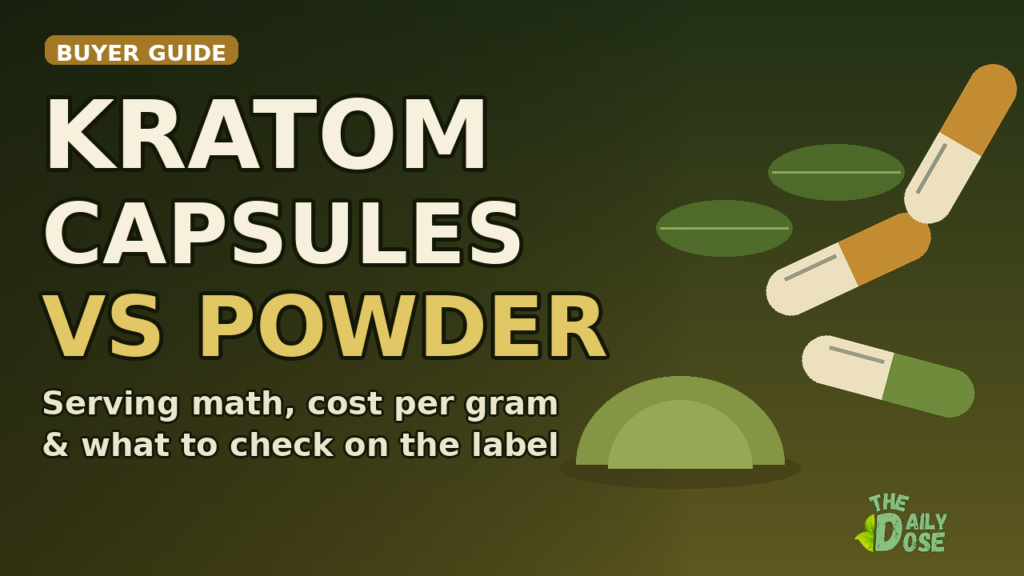
Kratom capsules are typically that same powder measured into “00” or “000” size capsules. A size 00 capsule usually holds somewhere around 0.5 grams of leaf powder, though the exact fill depends on the brand and how densely the powder is packed. The shell is usually gelatin or a plant-based (vegetarian) cellulose. That is it — for plain leaf capsules there is no magic beyond portioning.
Kratom Capsules vs Powder: Side-by-Side
Convenience and portability
Capsules win here, no contest. No scale, no spoon, no mess, no tossing a bag into your gym bag and finding a green dust cloud later. If you travel, work long shifts, or just want a grab-and-go routine, capsules are the easy option.
Taste
Let me be straight with you: kratom powder tastes bitter and earthy. Some people do not mind it; many do. The traditional “toss and wash” method (a measured spoonful followed by water), mixing into juice, or stirring into a tea are common workarounds. Capsules skip the taste entirely, which is one of the biggest reasons people switch.
Measuring precision
Powder gives you the most flexibility. With a small digital kitchen scale that reads in tenths of a gram, you can portion very precisely and adjust in small steps. Capsules lock you into fixed increments based on the fill size — fine for consistency, less flexible for fine-tuning.
Timing
Because a capsule shell has to dissolve before the powder is released, many people notice capsules take a little longer to “kick in” than loose powder. Think of it as a timing difference, not a strength difference. It also means a common mistake is taking more capsules too soon because “nothing is happening yet.” Patience is part of responsible use.
Price
Powder is almost always cheaper per gram. You are paying for the capsules, the capsule-filling labor or machinery, and often smaller pack sizes. More on that math below.
Serving Size Math: Grams, Capsules, and Teaspoons
This is where I want you to slow down, because it is the part shoppers get wrong most often. The useful number is grams of leaf per serving, not “number of capsules” and not “one scoop.”
- Capsules: Check the label for milligrams per capsule. If a capsule holds 500mg, then four capsules equal 2 grams of leaf. If the label does not say how much is in each capsule, that is a gap worth asking the brand about.
- Powder by teaspoon: A level teaspoon of kratom powder is often cited at roughly 2 to 3 grams, but density varies by grind and how loosely the powder is packed. Spoons are an estimate.
- Powder by scale: A small digital scale is the most accurate way to measure loose powder, and it is a cheap tool that pays for itself in consistency.
I am not going to hand out a serving recommendation here — follow the label on the specific product, start at the low end, and do not stack servings in a short window. If you are switching from powder to capsules (or the reverse), match the grams, not the habit. Switching from “two spoonfuls” to “two capsules” is not an apples-to-apples swap.
Cost per Gram: The Number Most Shoppers Skip
Here is the quick way I compare any two kratom products:
- Find the total grams in the package (for capsules: number of capsules × mg per capsule ÷ 1,000).
- Divide the price by total grams.
- Compare that cost per gram across formats and brands.
Example with round numbers: a $30 bag holding 250 grams of powder works out to about 12 cents per gram. A $30 bottle of 120 capsules at 500mg each holds 60 grams total — about 50 cents per gram. Same plant, roughly four times the cost per gram for the convenience. That might be totally worth it to you. Just know you are paying for it.
Where Extract Capsules and Shots Fit
This is important enough to get its own section. Kratom extract capsules, extract tablets, and extract shots are not the same thing as plain leaf capsules. Extracts are concentrated — alkaloids are pulled from a larger amount of leaf and condensed into a smaller serving. They are labeled differently (often by milligrams of mitragynine or by extract ratio), and they should never be swapped gram for gram with plain leaf powder or capsules.
If you are new to kratom, my honest take is to understand plain leaf products first. Extracts are a separate shopping decision with their own label-reading rules, and we keep them in their own aisle — Kratom Extract Capsules — for exactly that reason.
Quality Checks: Labels, Lab Reports, and Red Flags
Format is the easy decision. Quality is where you protect yourself. Whether you buy capsules or powder, here is my checklist:
- Strain or vein name. “Maeng Da,” “Red Bali,” “Green Malay,” “White Vein” — whatever it is, it should be named. A bag that just says “kratom” gives you nothing to compare.
- Grams or mg per capsule. Net weight for powder, fill weight for capsules. No exceptions.
- Batch-matched lab report. Look for third-party testing for alkaloid content and safety screens: heavy metals (lead, arsenic, cadmium, mercury), microbes like salmonella and E. coli, and ideally yeast and mold. Some brands provide reports on request — “available upon request” is fine as long as they actually send it.
- Clean ingredient list. Plain leaf capsules should list kratom leaf and the capsule material. Be cautious with unlabeled additives or “enhanced” blends without numbers.
- Industry standards. Some states have adopted a Kratom Consumer Protection Act (KCPA) with labeling, age, and testing rules. Brands that follow those standards are generally easier to trust.
Legal and Shipping Notes (High Level)
Kratom is legal at the federal level in the US, but it is not legal everywhere. Several states — including Alabama, Arkansas, Indiana, Rhode Island, Vermont, and Wisconsin — restrict or ban it, and some cities and counties have their own rules. Other states regulate it through KCPA-style laws with age limits (often 21+) and labeling requirements. Rules change, so treat this as a starting point, not legal advice.
Before you order, check our Product Warnings & Disclosures page and your state and local law. If we cannot ship to your area, that is the reason — it is not a format issue.
Our Shelf Picks Compared
Here is how the live kratom products on our shelf break down by format. I am describing what is on the label — not making effect promises — so you can pick the format that fits your routine.
Leaf Organix Kratom Powder
Leaf Organix Kratom Powder is a solid example of what to look for in a powder: the label lists a 1.8% alkaloid content and lab testing, and it comes in named strains like Maeng Da plus red and white vein options. Good pick if you want flexibility and a scale-measured routine.
Leaf Organix Kratom Capsules 360ct
If you like the Leaf Organix line but want the convenience route, Leaf Organix Kratom Capsules (360ct) come in a bulk count that helps the cost per gram. The listing notes finely ground powder with no stems and lab testing available on request.
OPMS Silver Kratom Powder vs OPMS Silver Capsules
OPMS is one of the most recognized names in the space, and it is a great brand to compare formats side by side. OPMS Silver Kratom Powder comes in a 4oz bag across strains, while OPMS Silver Kratom Capsules (32ct) are the try-it-first size — and there is a 64ct pack if you already know you like the format. Run the cost-per-gram math between them and you will see the convenience premium in action.
Bulk options for both formats
Already know your format? Our bulk kratom capsules (1600ct) and bulk kratom powder are the value play. Bulk only makes sense once you have tried a strain and format and know it fits — I would not start there.
Browse by format
Want to see everything? Browse Kratom Capsules or Kratom Powder, and keep extracts separate in Kratom Extract Capsules.
My Thoughts
I will tell you how I think about this personally. When I first started paying attention to botanicals, I assumed capsules were the “beginner” option and powder was for people who “really knew what they were doing.” That framing is wrong. Capsules are just a delivery format — and a pretty good one for consistency.
Where I see people get into trouble is not the format. It is skipping the label math, swapping powder spoonfuls for capsule counts without converting to grams, getting impatient with capsules and doubling up, or treating extracts like plain leaf. Fix those four habits and the capsules-versus-powder question becomes a simple lifestyle preference.
My other bias: respect the plant. Kratom is a strong botanical, and regular, heavy use carries real risks, including dependence. Go low, keep it occasional, do not mix it with alcohol or other substances, and talk to a clinician if you have questions about your health or medications. That is not me being dramatic — that is the same respectful approach I bring to everything we discuss on the show.
FAQ
Are kratom capsules weaker than powder?
Not inherently. Plain leaf capsules usually contain the same powder, just pre-portioned. What differs is how many grams you are actually taking. Compare grams per serving, not capsule count versus spoonfuls.
How many grams are in a kratom capsule?
It depends on the capsule size and fill. A size 00 capsule commonly holds around 0.5 grams, but always check the label on the specific product for the exact milligrams per capsule.
Is kratom powder cheaper than capsules?
Almost always, on a cost-per-gram basis. Divide price by total grams to compare. Bulk sizes of either format usually lower the per-gram cost.
Are kratom extract capsules the same as regular kratom capsules?
No. Extract capsules, tablets, and shots are concentrated and labeled differently. Never treat them as interchangeable with plain leaf capsules or powder.
Is kratom legal where I live?
It depends. Kratom is federally legal in the US but banned or restricted in some states and localities, and many states set age limits. Check your local law and our Product Warnings & Disclosures page before ordering.
Soft Disclaimer
This article is for educational shopping purposes only and is not medical or legal advice. Kratom products are not intended to diagnose, treat, cure, or prevent any disease, and these statements have not been evaluated by the FDA. Kratom is not FDA-approved for any use. For adults only; follow age rules where you live. Start low, avoid combining with alcohol or other substances, do not drive after use, and keep products away from children and pets. Consult a qualified healthcare professional before use if you are pregnant or nursing, take any medication, or have a medical condition. See our Product Warnings & Disclosures for more.
Want more practical botanical guides? Check out Best Nootropics for Focus, Ashwagandha for Stress, and Full Spectrum vs Broad Spectrum vs Isolate CBD — and catch the next episode of The Daily Dose Podcast.