To Listen To The Full Audio Episode Click Here: The Daily Dose Podcast Audio
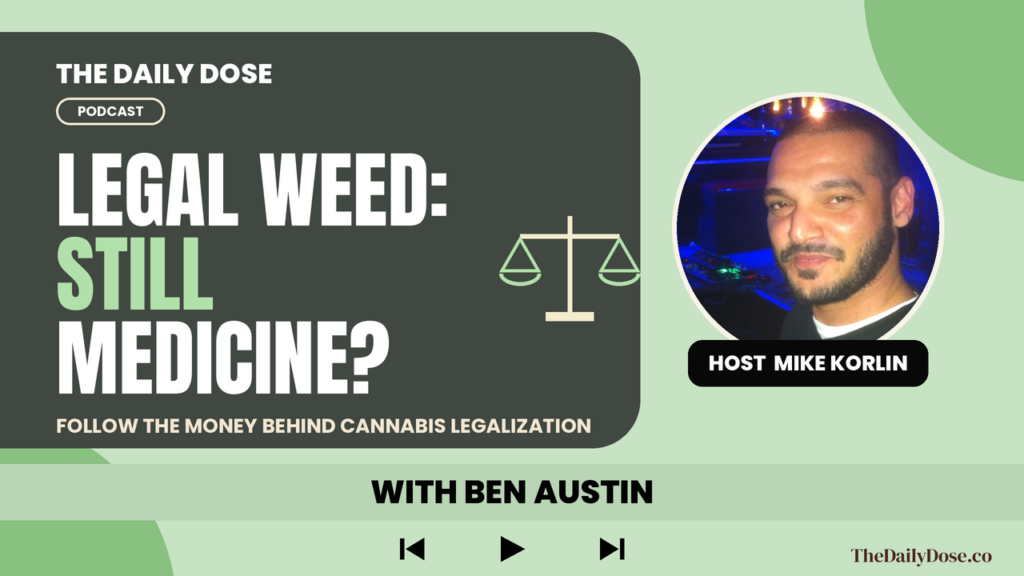
Cannabis is pretty much everywhere now, in every major city and even in small towns across the country. That is exactly why I wanted this conversation. In this episode of The Daily Dose Podcast I sat down with Ben Austin for a long, honest talk about what legalization really looks like, who benefits from it, and whether the plant that started as medicine is still being treated that way. Ben and I have both spent years around cannabis and its derivatives as consumers, retailers and advocates, so we have seen a lot of the changes up close.
My opening question in the episode is one I keep coming back to: why now? Public opinion has been moving toward legalization for a long time, so why does it feel like everything is happening at once? We follow that question through money, taxes, licensing, lab testing, the plant itself, and the people who get lost along the way. This post is a summary of what we talked about and the opinions we shared, not medical, legal or financial advice. If you want the whole thing, press play on the audio player above.
Key Takeaways
- Why now? We question why legalization is accelerating at this point in history and argue that taxes, control and business interests are a big part of the answer.
- Legalization vs. descheduling: Ben’s view is that removing cannabis from the federal controlled substance schedules would do more for everyday people than a corporate-friendly federal legalization framework.
- Small growers get squeezed: licensing, compliance costs and retail gatekeeping can push out the craft growers who built the industry.
- Labels are only part of the story: high THC numbers dominate the conversation while the wider range of cannabinoids and terpenes gets far less attention, and we talk about why lab results deserve a closer look.
- Education at the counter matters: the advice a first-time customer hears in a couple of minutes can shape how they feel about cannabis for years.
- Hemp has a bigger story: from historic farm crops to sustainability, hemp came up as a topic that deserves more attention.
Table of Contents
- Meet the Guest: Ben Austin
- Cannabis Then and Now: Is It Still Medicine?
- Following the Money: Why Legalization, Why Now?
- Legalization, Decriminalization and Descheduling
- Small Growers, Big Companies and the Gatekeepers
- Reading the Label: THC Numbers, Cannabinoids and Terpenes
- Whole Plant vs. Isolated Compounds
- Education at the Counter
- Hemp, History and Sustainability
- Where I Land After This Conversation
- FAQ
- A Note on Perspective
Meet the Guest: Ben Austin
Ben Austin is a podcaster and long-time cannabis advocate. He hosts a show of his own, which you can find through his link page, and he spent time working inside the legal cannabis industry in Washington State. He now lives right on a state border, so he has a very direct view of how different rules on either side of a line can change everyday life.
We start the episode with a bit of podcasting talk and a shared belief that education is what moves any movement forward. From there we get into the heart of the conversation: cannabis then and now.
Cannabis Then and Now: Is It Still Medicine?
Cannabis was originally legalized in many places as medicine. Under those early medical programs, the focus was on patients and on access. Over the years larger business interests have moved in, and with them came a whole new product line. In our view, a lot of what made the early system work has been changed or lost along the way.
That is the question behind the episode title. I am not making health claims here, and I am not saying cannabis is or is not a treatment for anything. What I am saying is that the way cannabis is grown, tested, packaged and sold has shifted a lot, and that shift is worth understanding. If you want a neutral overview of what cannabis and cannabinoids are, the National Center for Complementary and Integrative Health is a good place to start.
Following the Money: Why Legalization, Why Now?
When I look at why legalization is moving now, I look at human nature and ask who benefits. We talk through a few angles:
- Tax revenue: retail cannabis can be taxed at multiple levels, from the business side to the customer’s receipt, and that money flows to state and federal governments.
- Control: a regulated market means the rules, the licenses and the permitted products are decided by those in charge, which is not the same thing as freedom for consumers.
- Business expansion: larger companies in other industries already have the infrastructure, the capital and the lawyers to move in quickly once the rules allow it.
We even speculate about how much of today’s momentum may be about these bigger-picture reasons rather than simply what people want. I should be clear that these are our opinions and observations from the episode, and you should weigh them alongside other sources.
Legalization, Decriminalization and Descheduling
One of the main threads in the episode is the difference between a few related ideas. In plain terms:
- Legalization usually means a government sets up rules that allow regulated sales and use.
- Decriminalization generally means reducing or removing criminal penalties for certain activities.
- Descheduling means taking cannabis off the federal list of controlled substances altogether.
Ben’s view, which I found compelling, is that federal legalization on its own could open the door to corporate consolidation while leaving everyday consumers in a gray area, and that descheduling and decriminalizing would do more to address things like past offenses and long sentences. We also point out how convenient it can feel when “righting past wrongs” is talked about at the same moment a big market opens up. Laws vary a lot by state and country and they change often, so please check your local rules.
Small Growers, Big Companies and the Gatekeepers
Ben joined the Washington State industry roughly a year or so after legalization, so he saw a lot of the early growth from the inside. We talk about several things that stood out:
Licensing tiers and craft cannabis
Washington’s license structure is based on how much canopy space a grower can have. Ben describes how only a small slice of the market remained with the smallest tier, even though those are often the growers focused on craft quality.
Purchasing managers and shelf space
A retailer’s buyer can decide which farms get onto the shelves. For small farms without relationships or the resources to send samples and cover delivery costs, that gatekeeping can be a major barrier.
Ownership and conflicts of interest
We also talk about how ownership can overlap across growing, lab testing and retail, and why that raises questions about conflicts of interest. As you listen, you will hear that this is Ben’s perspective from his time in the industry, and we both think more transparency would help.
The same story in California
I share that I saw similar patterns in California, where growers who were compliant under the older medical rules found the new system harder to navigate.
Reading the Label: THC Numbers, Cannabinoids and Terpenes
This was one of my favorite parts to talk through. Today the conversation is dominated by one number, the THC percentage. We discuss why that number only tells part of the story:
- Cannabinoid variety: cannabis contains many compounds, and many of them are rarely mentioned on a package. Researchers are still learning what they all do.
- Terpenes: these aromatic compounds are part of what gives each strain its character. We talk about how growing conditions can change them and how some products add terpenes back in later.
- Strain names: with so much crossbreeding, we wonder how meaningful labels like indica and sativa are anymore, since most of what is on the shelf is a hybrid.
- Trust in testing: Ben shares concerns from his time in the industry about how much confidence to place in printed numbers, and why chain of custody and who actually tested a product matter.
My practical takeaway is simple: read the lab report, check who performed the test, and ask questions. If a label says a contaminant panel was not tested, that is worth noticing. None of this is a substitute for advice from a qualified professional about your own situation.
Whole Plant vs. Isolated Compounds
We spend time on the idea that cannabis is more than the sum of its parts. In my words, cannabis is magic, because we do not yet fully know everything inside the plant or how it all works together. Our concern is that the industry tends to isolate and profit from single compounds instead of respecting the whole plant.
We also talk about synthetic and lab-made cannabinoids from the pharmaceutical world and how hard it is to replicate what nature does. We use an older synthetic cannabinoid medication as an example of an approach that did not catch on commercially. I also clarify that hemp-derived compounds such as delta-8 are a different conversation from pharmaceutical synthetics. Rick Simpson Oil (RSO) comes up as an example of a whole-plant preparation. I am not making any health claims about it here, and nothing in this post is advice on how to use any product.
If you want to learn more about how different cannabinoid profiles are described on products, see our guide to full spectrum, broad spectrum and isolate CBD.
Education at the Counter
I have a lot of respect for people who take the time to explain things, and this part of the episode is personal for both of us. We share stories about how quickly a poor first experience can turn someone away from cannabis for good, often because they were handed a product that was far too strong for a newcomer, without enough explanation. People tend to go to the dispensary for knowledge, and yet the person behind the counter often has only a couple of minutes and a sales target.
A few ideas we land on:
- Slow down and ask questions. Understand what someone is going through and what they hope to achieve before recommending anything.
- Set realistic expectations. Any plant-based product is not a quick fix, and it will not undo everything else going on in someone’s life.
- Make room for the wellness conversation. We suggest that retailers could offer a quieter space for longer one-on-one conversations, since the party atmosphere can put off people who are looking for wellness information.
- Be honest about what we do not know. Sometimes the best answer from a retailer is to send someone to a qualified professional.
I also talk about the “Mary Kay of CBD” problem, where shops carry any product they can get without knowing much about it. The word I came away with was hope. People come looking for hope, and I take that seriously.
Hemp, History and Sustainability
Toward the end we talk about hemp. Historically, hemp was a major farm crop in the United States and was used for things like paper, fabric and rope. We discuss how hemp could be part of a conversation about sustainability, and how public attitudes toward both hemp and cannabis seem to be shifting around the world.
We also touch on the black market, which many people feel is fueled by high taxes and decades of the drug war, and on the environmental damage that can come from illegal grow operations. These are big topics with a lot of nuance, and I would encourage you to read more from a variety of sources.
Where I Land After This Conversation
Cannabis is more mainstream than ever, and a lot of people are benefiting from that in real ways. At the same time, I believe it is important to ask who the system is actually built for, what is getting lost in the process, and how consumers can protect themselves with good information. Education is what I come back to every time.
If you are looking for CBD products, you can browse our CBD collection, and you can read our product warnings and disclosures before you buy anything. Thank you for the ears, eyes and your time.
FAQ
That is the question we explore in the episode. Cannabis was originally legalized in many places through medical programs, and we discuss how larger commercial interests have changed the way it is grown, tested and sold. I am not making health claims here. If you are thinking about using any cannabis or hemp product for a health reason, please talk to a qualified healthcare professional first.
Legalization generally means a government creates rules that allow regulated sales and use. Decriminalization generally means reducing or removing criminal penalties. Descheduling means removing cannabis from the federal controlled substance schedules. In the episode, Ben argues that descheduling would help everyday people more than corporate-friendly legalization. Laws vary by state and country and change often, so check your local rules.
Our view is that tax revenue, regulation and business expansion are major drivers, and that the people who benefit most are not always the consumers or the growers who built the industry. That is our opinion from the conversation, and I encourage you to compare it with other sources.
Cannabis contains many compounds, including other cannabinoids and terpenes, and a label usually highlights only one or two numbers. In the episode we talk about why it is worth reading the full lab report, looking at who performed the test and asking questions before you buy.
For newcomers, a first experience with a product that is too strong or poorly explained can turn them away from cannabis for good. We argue that retailers should slow down, ask questions, set realistic expectations and be willing to send people to a qualified professional when needed.
This episode was recorded in 2022, and cannabis laws, taxes and licensing rules change often. Treat the conversation as a snapshot of our views at that time and check official sources for current information.
A Note on Perspective
This post summarizes an interview and reflects the opinions of the host and the guest. It is for educational purposes only and is not medical, legal or financial advice. Statements about products, companies and industry practices are personal views and experiences shared in the episode. Please talk to a qualified professional about your own health, and check your local laws.
Related Articles:
- Full Spectrum vs Broad Spectrum vs Isolate CBD
- Delta 8 THC Gummies: What Shoppers Should Know
- Border Crisis Patrol Officer Carrell Talks
- Shop CBD at The Daily Dose
#cannabis #cannabislegalization #cannabisinfo #cannabiseducation #420education #cbd #cannabinoids #weed #stonertalk #learnaboutcannabis #learnaboutcbd #learnabouthealth #thedailydose
Meet The Author