Checkout the full episode of the interview here: The Daily Dose Podcast Audio
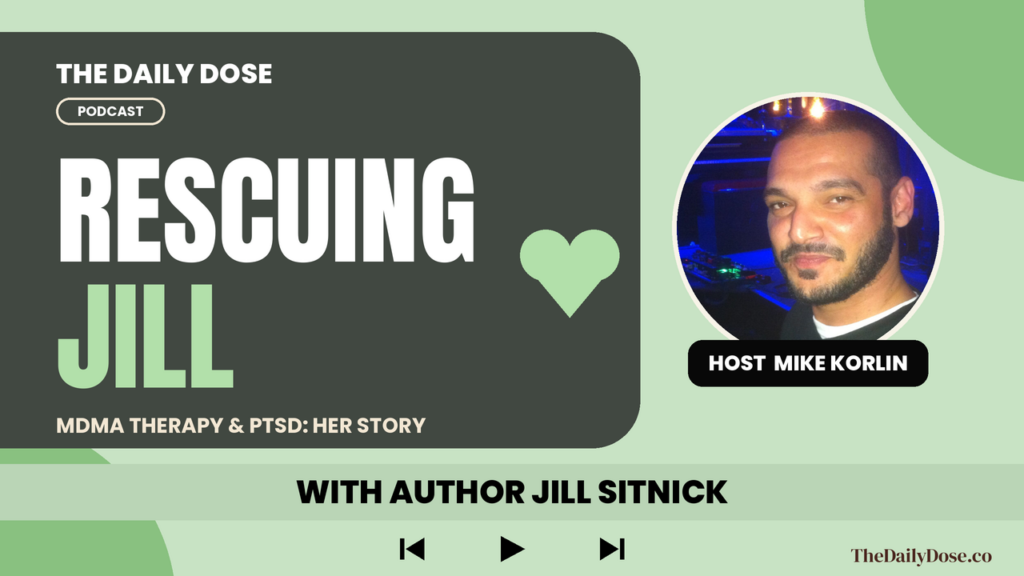
Today on The Daily Dose Podcast we talk about mental and emotional health in our society with a special guest, author Jill Sitnick. Jill has lived quite a life. She was diagnosed with PTSD and was reluctant to believe it, but the evidence that kept showing up was compelling enough to change her mind.
This is a sensitive subject, and I want to be upfront: this episode is her personal story and an educational conversation. It is not medical advice and it does not recommend any treatment. Please speak with a qualified professional about your own care.
Key Takeaways
- Jill Sitnick is an author who shares her personal story of living with PTSD in this interview.
- She was reluctant to accept her diagnosis at first, but as evidence continued to appear, she changed her mind.
- In the episode she revisits some of her most intimate childhood memories to understand the traumas of the past.
- With the guidance of a caregiver and a medical professional, she explored psychedelic-assisted therapy, after months of researching and learning about the space.
- The episode is about her personal experience, not a recommendation. Research into MDMA-assisted therapy is ongoing, and legal status and eligibility vary.
- If you are struggling, a licensed professional is the right place to start.
Table of Contents
- Meet the Guest: Jill Sitnick
- The Bigger Picture: Mental Health Today
- What the Episode Explores
- About the Research
- Final Thoughts
- FAQ
- Educational Disclaimer
Meet the Guest: Jill Sitnick
Jill Sitnick is an author. In this interview she talks about her path from doubting a PTSD diagnosis to accepting it, and about what led her to learn about MDMA therapy. She credits her caregiver and a medical professional for first introducing her to the possibility of exploring psychedelics. She had never considered it an option, but with time running out and a feeling of urgency growing, she took the leap after months of research.
The Bigger Picture: Mental Health Today
In the post I noted that tens of millions of people around the world live with symptoms of depression, anxiety, stress, PTSD, and more. For many, it can feel like a hopeless cycle of trying new options that help a little or make things worse. I believe that the underlying causes are not discussed enough.
What the Episode Explores
Here is what you can expect in the full interview:
- Her diagnosis story: how a skeptical person came to accept the PTSD diagnosis.
- Childhood memories: how looking back at the earliest memories helped her understand where the pain began, in her telling.
- Deciding to explore therapy: the months of research and the guidance from professionals before she made her decision.
- Why people are curious: psychedelics have been described by some as a window into the self that trauma can block off, and people are exploring controlled, professionally guided therapy settings.
About the Research
Research in this area continues. In the original post I pointed readers to MAPS, an organization that shares research on psychedelic-assisted therapy. Please look at that research yourself, read it critically, and talk to your own clinician. Its legal status depends on where you live, and it can carry real risks. Nothing in this post is guidance on use, dosing, or access.
For a related look at this topic on our site, see our conversation with DJ Kadagian, Near Death and Psychedelics, and the follow-up clip, Childhood Trauma and Jill Sitnick’s story.
Final Thoughts
Hearing a story like Jill’s reminds me that behind every statistic there is a person. Thank you for watching or listening to this episode of the Daily Dose on MDMA therapy for PTSD. If it resonates with you, remember that support is available.
If you are in crisis or thinking about harming yourself, call or text 988 in the U.S. (the Suicide and Crisis Lifeline) or contact your local emergency services.
FAQ
Jill Sitnick is an author who shares her personal experience with PTSD and with MDMA therapy in this interview.
She was reluctant at first, but the evidence that kept presenting itself was compelling enough to change her mind.
Her caregiver and a medical professional introduced her to the possibility. After months of researching and learning, she decided to take that step.
No. It is one person’s story. Research is ongoing, and treatment decisions should be made with a licensed professional. Laws about MDMA vary by location.
Researchers are studying them for conditions such as depression, anxiety, and PTSD. Studies are still in progress, and results do not apply to everyone.
Educational Disclaimer
This article is for educational purposes only and summarizes a podcast interview. It is not medical or mental health advice and is not intended to diagnose, treat, cure, or prevent any condition. It does not promote or provide instructions for using any controlled substance. The views belong to the host and guest. If you are struggling with trauma or PTSD, please talk to a qualified mental health professional.
Related Articles:
- Mental Health & Self Discovery Kyle Lynch
- Mental Health Treatment: The Therapy Twins
- Near Death And Psychedelics DJ Kadagian
- Understanding Depression Reasons Behind It
- What Drives Human Nature The Will To Live
Meet The Author